what was president martin van burens new solution to the problem of what to do about
 Van Buren at the beginning of his presidency (1837–38) | |
| Presidency of Martin Van Buren March 4, 1837 – March four, 1841 | |
| Cabinet | See list |
|---|---|
| Political party | Democratic |
| Election | 1836 |
| Seat | White House |
| | |
| Seal of the President | |

The presidency of Martin Van Buren began on March iv, 1837, when Martin Van Buren was inaugurated as President of the Us, and ended on March 4, 1841. Van Buren, the incumbent vice president and chosen successor of President Andrew Jackson, took office as the eighth Us president afterwards defeating multiple Whig Political party candidates in the 1836 presidential election. A member of the Democratic Party, Van Buren's presidency ended following his defeat by Whig candidate William Henry Harrison in the 1840 presidential election.
The central consequence facing President Van Buren was the Panic of 1837, a sustained economic downturn that began just weeks into his presidency. Van Buren opposed any direct federal government intervention and cutting back federal spending to maintain a balanced budget. He also presided over the institution of the independent treasury system, a series of authorities vaults that replaced banks as the repository of federal funds. Van Buren continued the Indian removal policies of the Jackson administration, as thousands of Native Americans were resettled due west of the Mississippi River during his presidency. He sought to avoid major tensions over slavery, rejecting the possibility of annexing Texas and appealing the case of United States v. The Amistad to the Supreme Court. In foreign diplomacy, Van Buren avoided state of war with U.k. despite several incidents, including the bloodless Aroostook War and the Caroline Affair.
Van Buren's inability to deal effectively with the economic crunch, combined with the growing political strength of the opposition Whigs, led to his defeat in the 1840 presidential election. His four-twelvemonth presidency was marked equally much by failure and criticism as by success and popular acclaim, and his presidency is considered average, at best, by historians. His well-nigh lasting achievement was as a political organizer who built the modern Autonomous Political party and guided it to dominance in the new 2d Party System.[1]
Presidential ballot of 1836 [edit]
Van Buren had emerged equally President Andrew Jackson's preferred successor during the Petticoat affair, and Van Buren won election as vice president in 1832.[2] The 2 men –charismatic "Sometime Hickory" and the super-efficient "Sly Fox"—had entirely different personalities simply had become an effective team in eight years in office together.[three] Jackson declined to seek some other term in the 1836 presidential election, but he remained influential within the Autonomous Party, and he strongly supported Van Buren's candidacy in the 1836 ballot.[iv] With Jackson's back up, Van Buren won the presidential nomination of the 1835 Democratic National Convention without opposition.[5] 2 names were put frontwards for the vice-presidential nomination: Representative Richard M. Johnson of Kentucky, and onetime senator William Cabell Rives of Virginia. Though about Southern Democrats favored Rives, Jackson preferred Johnson, and his influence helped atomic number 82 to Johnson's nomination for the vice presidency.[6] [5]

1836 electoral vote results
The newly-established Whig Party, a loose coalition spring by mutual opposition to Jackson, sought to prevent Van Buren'south victory in the election of 1836. Defective the party unity or organizational strength to field a single ticket or define a single platform, the Whigs fielded multiple candidates in the hope of forcing a contingent election in the House of Representatives.[6] Senator Hugh Lawson White of Tennessee, a former Jackson marry, emerged as the major Whig candidate in the South, touting himself as the only Southerner in the race. William Henry Harrison, who had gained notoriety for his service in the Battle of Tippecanoe, edged out Senator Daniel Webster to become the master Whig candidate in the North.[7] The Whig Party campaigned on the themes of Jackson's declared executive tyranny, and attacked Van Buren as an untrustworthy career politician.[eight]
Van Buren had to articulate a position on slavery that could win full-throated blessing in both the pro-slavery South and the Northern states where slavery was illegal and unpopular. The biggest claiming came in the South, where all Yankees were automatically suspect on the slave question.[ix] Van Buren moved to obtain the support of Southerners by assuring them that he opposed abolitionism and supported the continued existence of slavery in states where information technology was present.[10] Van Buren did not discuss his own personal behavior, which held that slavery was immoral, only was sanctioned by the Constitution.[xi] Van Buren's strategy was not to defend his personal position, but to assault abolitionists, who were popular nowhere in the United States. Equally vice president, he cast the tie-breaking Senate vote in favor of a bill to discipline abolitionist mail to state laws, thus ensuring that abolitionist mail would not be circulated in the South. While Southern Whigs cast doubt on his devotion to slavery, his supporters insisted he believed in three things: that Congress could not interfere with slavery in u.s.a., that it would be "impolitic" to abolish slavery in the District of Columbia, and that agitation about slavery endangered the matrimony. Van Buren and his supporters realized that to build a viable national party and to maintain the union they had to compromise past accepting slavery. The Democrats created the first modern party, just in doing so consciously removed slavery and abolition from the partisan agenda. In 1848, Van Buren became a leading opponent of the extension of slavery in the North, but by so he had abased any promise of Southern back up.[12]
Van Buren won the election with 764,198 popular votes, 50.9 pct of the total, and 170 balloter votes. Harrison led the Whigs with 73 electoral votes, White receiving 26, and Webster 14.[13] Willie Person Mangum received South Carolina's 11 electoral votes, which were awarded by the state legislature. Compared to Jackson's 1832 campaign, Van Buren performed better in New England just worse in the S and West.[xiv] Van Buren's victory resulted from a combination of his own attractive political and personal qualities, Jackson'southward popularity and endorsement, the organizational power of the Autonomous party, and the inability of the Whig Party to muster an effective candidate and campaign.[15] Virginia'southward presidential electors voted for Van Buren for president only William Smith for vice president, leaving Johnson one electoral vote short of election.[16] In accord with the 12th Amendment, the Senate elected Johnson vice president in a contingent vote.[14] Meanwhile, in the concurrent congressional elections, Democrats retained control of both houses of Congress.[17]
The ballot of 1836 marked an important turning point in American political history because of the part information technology played in establishing the Second Party Arrangement. In the early 1830s the political political party structure was still changing rapidly, and factional and personal leaders continued to play a major role in politics. Past the end of the campaign of 1836, the new party system was almost fully formed, equally nearly every faction had been absorbed by either the Democrats or the Whigs.[18] [19]
Inauguration [edit]
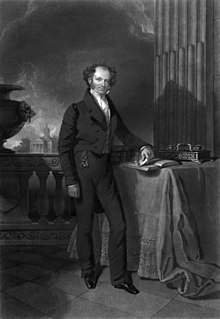
Portrait of Martin Van Buren
Van Buren was sworn in equally president by Supreme Court Main Justice Roger Taney on March 4, 1837, in a ceremony held on the Due east Portico of the U.s. Capitol.[20] At age 54, he was the youngest person at the fourth dimension to assume the presidency. Taking the adjuration as the eighth president, Van Buren defined his role as ane of preservation: "sacredly to uphold those political institutions" created by the Founders and peculiarly to safeguard the hallowed Jeffersonian principles of a limited national government and the liberty and sovereignty of "the people and the states."[21]
The inauguration marked the difference of a vital personality–Jackson–and the arrival of his chosen successor–Van Buren–in a new presidential dynasty. They rode together in a small phaeton (built from the wood of USS Constitution) drawn by four greyness horses.[22] This was the first time that the outgoing president and incoming president rode together to the Capitol.[20] The days festivities proved less a celebration of the incoming president than a tribute to the outgoing one. Van Buren's inaugural accost took wistful note of information technology:
In receiving from the people the sacred trust twice confided to my illustrious predecessor, and which he has discharged so faithfully and then well, I know that I tin can not wait to perform the backbreaking chore with equal ability and success. Only...I may promise that somewhat of the same cheering approbation will be constitute to attend upon my path.[23]
Administration [edit]
Chiffonier [edit]
| The Van Buren Cabinet | ||
|---|---|---|
| Function | Proper name | Term |
| President | Martin Van Buren | 1837–1841 |
| Vice President | Richard Mentor Johnson | 1837–1841 |
| Secretarial assistant of State | John Forsyth | 1837–1841 |
| Secretary of the Treasury | Levi Woodbury | 1837–1841 |
| Secretarial assistant of War | Joel Roberts Poinsett | 1837–1841 |
| Attorney General | Benjamin Franklin Butler | 1837–1838 |
| Felix Grundy | 1838–1840 | |
| Henry D. Gilpin | 1840–1841 | |
| Postmaster General | Amos Kendall | 1837–1840 |
| John Milton Niles | 1840–1841 | |
| Secretary of the Navy | Mahlon Dickerson | 1837–1838 |
| James Kirke Paulding | 1838–1841 | |
Van Buren retained much of Jackson'due south cabinet and lower-level appointees, as he hoped that the retentiveness of Jackson'southward appointees would halt Whig momentum in the South and restore conviction in the Democrats as a party of sectional unity.[24] The cabinet holdovers represented the different regions of the state: Secretary of the Treasury Levi Woodbury came from New England, Chaser Full general Benjamin F. Butler and Secretary of the Navy Mahlon Dickerson hailed from the mid-Atlantic states, Secretary of State John Forsyth represented the South, and Postmaster Full general Amos Kendall of Kentucky represented the West. For the position of Secretary of State of war, the lone unfilled post in the chiffonier, Van Buren showtime approached William Cabell Rives, who had sought the vice presidency in 1836. After Rives declined to join the cabinet, Van Buren appointed Joel Roberts Poinsett, a S Carolinian who had opposed secession during the Nullification Crisis.[25]
Van Buren's cabinet choices were criticized by Pennsylvanians such as James Buchanan, who argued that their country deserved a chiffonier position, as well as some Democrats who argued that Van Buren should have used his patronage powers to broaden his own power. But Van Buren saw value in avoiding contentious patronage battles, and his determination to retain Jackson's cabinet fabricated information technology clear that he intended to continue the policies of his predecessor. Additionally, Van Buren had helped select Jackson's cabinet appointees and enjoyed potent working relationships with them.[25]
Dissatisfied with the discipline and morale of the navy, Van Buren pressured Dickerson to resign in 1838, and Dickerson was succeeded by James M. Paulding.[26] That aforementioned twelvemonth, Butler resigned and was replaced with Felix Grundy, a Senator from Tennessee with close ties to Jackson. Grundy was later succeeded by Henry D. Gilpin of Pennsylvania.[27] John 1000. Niles, a party loyalist and former Senator from Connecticut, became Postmaster General in 1840.[28]
Van Buren was closely involved in foreign affairs and matters pertaining to the Treasury Section, but the Post Role, War Department, and Navy Department all possessed high levels of autonomy under their respective cabinet secretaries.[29] Van Buren held regular formal cabinet meetings and discontinued the informal gatherings of advisers that had attracted and so much attention during Jackson's presidency. Van Buren saw himself as "a mediator, and to some extent an umpire between the conflicting opinions" of his counselors. He solicited advice from department heads, tolerating open up and even frank exchanges between chiffonier members. The president'southward detachment allowed him to reserve judgment and protect his own prerogative for making final decisions.[30]
White House hostess [edit]
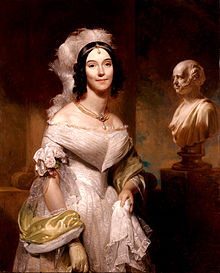
For the first half of his presidency, Van Buren, who had been a widower since the death of his married woman, Hannah Van Buren in 1819, did non take a specific person make full the role of White House hostess, instead assuming such duties himself. When his eldest son Abraham Van Buren married Angelica Singleton in 1838, the president quickly acted to install his daughter-in-law as his hostess. She solicited the advice of her afar relative, Dolley Madison,[31] who had moved back to Washington subsequently her husband's death,[32] and before long the president'southward parties livened up. After the 1839 New Year's Eve reception, the Boston Mail raved: "[Angelica Van Buren is a] lady of rare accomplishments, very modest yet perfectly easy and graceful in her manners and free and vivacious in her conversation ... universally admired."[31] Equally the nation endured a deep economic depression, newspaper coverage of Angelica Van Buren'due south receiving style at receptions, influenced past her heavy reading on European court life, as well as the anecdotal claim that she intended to re-landscape the White House grounds to resemble the royal gardens of Europe, were used to attack her father-in-law. Pennsylvania Whig Congressman Charles Ogle referred obliquely to her as part of the presidential "household" in his famous "Gold Spoon Oration."[33]
Judicial appointments [edit]
Van Buren appointed two associate justices of the Supreme Court. Congress had added 2 new seats on the Supreme Court with the Eighth and 9th Circuits Act of 1837, but President Jackson had filled merely ane of those positions. To fill the vacancy, in early 1837 Van Buren appointed Senator John McKinley of Alabama, a fundamental supporter of Van Buren's 1836 presidential campaign. A second Supreme Courtroom vacancy arose in 1841 due to the expiry of Philip P. Barbour. Van Buren appointed federal judge Peter Vivian Daniel to succeed Barbour.[34] Van Buren also appointed eight other federal judges, all to United States district courts.[35]
Domestic affairs [edit]
Panic of 1837 and treasury system [edit]
Panic of 1837 [edit]
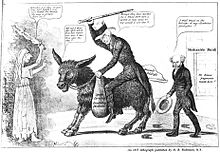
The modern balaam and his ass , an 1837 caricature placing the blame for the Panic of 1837 and the perilous state of the banking system on approachable President Andrew Jackson, shown riding a donkey, while President Martin Van Buren comments agreeably.
On May 10, 1837, some important state banks in New York, running out of hard currency reserves, all of a sudden refused to convert newspaper money into gilt or silver. Other financial institutions throughout the nation quickly followed accommodate, marker the offset of a financial crisis that would become known as the Panic of 1837.[23] The panic was followed past a five-year depression in which numerous banks failed and unemployment reached tape highs.[36]
Van Buren blamed the economic collapse on greedy business and financial institutions, too as on the over extension of credit by U.S. banks. Whig leaders in Congress, meanwhile, blamed Democratic economic policies, especially the 1836 Specie Round.[23] That policy had required the use of specie (coins), rather than paper coin, in the purchase of authorities-held lands, and had had the effect of transferring specie from Eastern banks to Western banks[37] and undermining confidence in banknotes.[38] Whigs likewise blamed Jackson's dismantling of the 2nd Bank of the United States, thereby allowing state banks to engage in lending and the printing of newspaper money without effective regulation.[39] Another contributing gene to the panic was the sudden contraction of English credit, which had helped to finance a period of strong economic growth since 1830.[twoscore]
Contained Treasury [edit]
While Whig leader Henry Dirt promoted his own American System every bit the all-time means for economical recovery, Van Buren's response to the panic focused on the practise of "strict economic system and frugality."[41] The potential repeal of the Specie Circular policy carve up the Democratic Party, with prominent Democrats like William Cabell Rives and Nathaniel Tallmadge urging it as part of a movement away from Jackson's hard currency policies.[42] After a long menstruation of consideration, Van Buren announced in May 1837 that he would non revoke the Specie Circular. Van Buren feared that revoking the Specie Round would injure western banks, and was reluctant to depart from a Jacksonian policy and then rapidly later on taking office.[43]
Van Buren'south decision to uphold the Specie Circular represented the starting time step in his delivery to the separation of the government from all banking operations, a policy that would get the central economical policy of his tenure. During Jackson's presidency, the federal government had moved its funds from the 2d Bank of the United states to and so-chosen "pet banks." Both the Second Depository financial institution of the United States and the pet banks had used those federal deposits to engage in regular cyberbanking activities, specifically the extension of loans. Van Buren sought to fully divorce the federal government from banking operations past establishing the Independent Treasury organisation, essentially a series of vaults, to hold government funds.[44] The Contained Treasury took its name from its supposed independence from banks and British creditors, as British creditors had fabricated large investments in the 2d Bank of the Us.[45] The Independent Treasury was inspired past the writings of William M. Gouge, a hard currency advocate who argued that any federal collaboration with banks both risked corruption and reinforced a speculative smash and bosom wheel that led to economic downturns.[46]
When the 25th Congress convened in September 1837, Van Buren introduced his legislation to create the Independent Treasury system.[47] Van Buren's programme immune the regime to accept paper money equally payment, simply the regime would seek to catechumen that newspaper coin to specie as quickly as possible.[48] State banking interests strongly opposed Van Buren'due south proposal, and an alliance of conservative Democrats and Whigs blocked the cosmos of the Independent Treasury System.[49] As the debate over the Independent Treasury continued, Rives and another Democrats defected to the Whig Party, which itself grew more unified in its opposition to Van Buren.[47] The Panic of 1837 loomed large over the 1837 and 1838 election cycles, as the carryover effects of the economic downturn led to Whig gains in both the House of Representatives and the Senate. The Democratic Party retained a bulk in both chambers later on the elections,[fifty] [51] simply a split among House Democrats led to the election of Whig Congressman Robert M. T. Hunter as Speaker of the House.[52] Meanwhile, Whigs won gains in state elections across the state, including in Van Buren'southward domicile country of New York.[53]
In early 1838, almost banks ended their moratorium on converting newspaper into money into gold or silver, temporarily bringing an cease to the monetary crunch.[54] The economic system began to recover, and an alliance of Democrats and Whigs repealed the Specie Circular that year. A 2d economic downturn, known as the Panic of 1839, began as the consequence of a cotton glut. With less income coming in from the cotton trade, land prices plummeted, industries laid off employees, and banks failed. According to historian Daniel Walker Howe, the economic crunch of the late 1830s and early 1840s was the well-nigh severe recession in U.South. history until the Groovy Depression.[55] Partly in response to this second economic downturn, Congress enacted Van Buren's Independent Treasury proposal in June 1840.[56] The Whigs would abolish the Independent Treasury system in 1841, but information technology was revived in 1846 and remained in place until the passage of the Federal Reserve Act in 1913.[57]
Reduction in working hours [edit]
In 1840, President van Buren issued an executive order which lowered the working hours for authorities workers to simply 10 hours per day.[58] This mostly included laborers and mechanics.
Indian removal [edit]
Federal policy under Jackson had sought, through the Indian Removal Act of 1830, to move all ethnic peoples to lands west of the Mississippi River. Continuing this policy, the federal government negotiated 19 treaties with Indian nations in the course of Van Buren'due south presidency.[59] By the time Van Buren took office, the Muscogee, Chickasaw, and Choctaw had been removed to lands west of the Mississippi River, but a large number of Cherokee were nonetheless in Georgia and the Seminole remained in Florida.[60] An 1835 treaty signed by U.S. government officials and representatives of the Cherokee Nation had established terms nether which the entire nation would cede its territory and move across the Mississippi River, just many Cherokee viewed the treaty equally fraudulent.[61] In 1838, Van Buren directed General Winfield Scott to forcibly move all those Cherokee who had not yet complied with the treaty.[62] The Cherokee were herded violently into internment camps, where they were kept for the summer of 1838. The bodily transportation west was delayed by intense heat and drought, merely in the autumn, the Cherokee reluctantly agreed to migrate west.[63] [64] During the Cherokee removal, part of the Trail of Tears, some 20,000 people were relocated confronting their volition.[65]

In the Florida Territory, the Seminole engaged the army in a prolonged conflict known as the 2nd Seminole War.[59] The Seminole were more resistant to removal than other tribes of the South due in large role to the influence of hundreds of escaped slaves and other African Americans who lived among the Seminole. These escaped slaves feared that the divergence of the Seminole would lead to their ain re-enslavement.[66] Prior to leaving part, Jackson had placed General Thomas Jesup in command of all U.S. troops in Florida in order to strength Seminole emigration to the Westward.[67] Forts were established throughout the Indian territory and columns of soldiers scoured the countryside. Feeling the pressure, many Seminoles, including head chief Micanopy, offered to surrender. The Seminoles slowly gathered for emigration near Tampa, only in June they fled the detention camps, driven off past disease and the presence of slave catchers who were hoping to take Blackness Seminoles captive.[68] [69]
In December 1837, Jesup began a massive offensive, culminating in the Battle of Lake Okeechobee. Following the American victory in the battle, the state of war entered a new stage, a long war of attrition.[68] During this time, the regime realized that it would exist almost impossible to drive the remaining Seminoles from Florida, so Van Buren sent Full general Alexander Macomb to negotiate a peace with the Seminoles. It was the only time in U.S. history that a Native American nation had forced the United States to sue for peace. An agreement was reached allowing the Seminoles to remain in southwest Florida, simply the peace was shattered in July 1839.[68] Fighting was not resolved until 1842, after Van Buren had left office. The The states spent over $30 million in the 2nd Seminole War, which besides toll the lives of over 1400 American armed services personnel, dozens of civilians, and at to the lowest degree vii hundred Seminole.[seventy]
Historian Laurence M. Hauptman argues that dishonest and underhanded methods were deliberately employed to remove the Iroquois and Stockbridge-Munsee Indians from their lands in upstate New York without payment. He states that federal officials, James W. Stryker, John F. Schermerhorn, and Random H. Gillet, collaborated with Van Buren in fraudulently imposing the 1838 Treaty of Buffalo Creek using bribery, forgery, corruption, and deception.[71] [72] Meanwhile in Michigan, the Ottawas managed to remain in their ancestral home land past threatening to bring together the British in neighboring Canada, and by becoming landowners who had a higher status and were of import factors in the local economy. They also deliberately sent their young men into the local wage labor market place to make their presence valuable to the white community. They never threatened the local whites and had meaning support from the community.[73]
Slavery [edit]
Slavery policy [edit]
The abolitionist move had gained in popularity during the 1830s, and the activism of abolitionist groups similar the American Anti-Slavery Guild prompted denunciations from Southern leaders like John C. Calhoun.[74] Van Buren viewed abolitionism every bit the greatest threat to the nation's unity. He opposed whatsoever endeavor on the function of Congress to abolish slavery in the Commune of Columbia against the wishes of the slave-holding states, and to resist the slightest interference with it in usa where it existed.[75] Reflecting the increasing importance of slavery as a topic of national argue, Van Buren was the first president to make use of the word "slavery" in an inaugural address, and his stances led to accusations that he was a "northern man with southern feelings."[76] However, Van Buren was also sensitive to northern concerns virtually the expansion of slavery, and he opposed the looting of Texas out of a desire to avoid sectional disputes.[77]
During Van Buren'southward presidency, congressional leaders sought to avoid divisive debates over slavery through the "gag rule," an informal practice in which any discussion of the abolitionism of slavery in Congress was immediately tabled. While the gag rule was largely successful in stifling the debate over slavery in the Senate, Congressman (and former President) John Quincy Adams earned notoriety for his efforts to resist the gag dominion in the House of Representatives.[78] Adams defeated an endeavor at censuring him, but a coalition of Southerners and Northern Democrats ensured that the gag dominion remained in place.[79] Equally the fence over slavery continued to gain prominence, a pocket-size grouping of anti-slavery activists founded the Liberty Party, which would nominate James G. Birney for president in the 1840 election.[80]
Amistad case [edit]
Like the British and Americans, the Spanish had outlawed the importation of slaves from Africa, but high slave mortality rates encouraged smugglers to smuggle captured slaves from Africa into Castilian colony of Cuba. In June 1839, several recently-kidnapped Africans took command of La Amistad, a slave ship headed to Republic of cuba. The Africans attempted to canvass dwelling, but were tricked by ane of the crew members into heading towards the Us, where the Africans were apprehended and brought before the federal court of Judge Andrew T. Judson.[81] The Spanish government demanded that the ship and its cargo (including the Africans) be turned over to them. The Van Buren administration, hoping to minimize the political domestic and international fallout from the incident, supported Spain'due south position at trial.[82]
Defying the expectations of nearly observers, Judson ruled that the defendants exist ready gratis. Later the federal circuit upheld Judson's ruling, the Van Buren administration appealed the case to the Supreme Court. In March 1841, the Supreme Court upheld Judson's ruling, property that the Africans had been kidnapped illegally. Afterwards the case, the abolitionists raised money to pay for the render of the Africans, and they departed from the United States in November 1841.[83] The unique nature of the Amistad case, involving international problems and parties, people of color testifying in federal court, and the participation of former president Adams and other high-profile lawyers, engendered great public interest. The Amistad instance drew attention to the personal tragedies of slavery and attracted new support for the growing abolition movement in the North. Information technology also transformed the courts into the principal forum for a national debate on the legal foundations of slavery.[84]
Mormons [edit]
In 1839, Joseph Smith Jr., the founder of the Latter Day Saint movement, visited Van Buren to plead for the U.S. to aid the roughly 20,000 Mormon settlers of Independence, Missouri, who had been forced from the land during the 1838 Mormon War. The Governor of Missouri, Lilburn Boggs, had issued an executive order on Oct 27, 1838, known as the "Extermination Order". It authorized troops to use force against Mormons to "exterminate or drive [them] from the state".[85] [86] In 1839, afterwards moving to Illinois, Smith and his political party appealed to members of Congress and to President Van Buren to intercede for the Mormons. According to Smith's grandnephew, Van Buren said to Smith, "Your cause is only, but I can practise goose egg for you; if I have up for y'all I shall lose the vote of Missouri".[87] [88]
Strange affairs [edit]
Texas [edit]
The Republic of Texas had gained de facto independence from Mexico in the Texas Revolution, and Texans had subsequently voted overwhelmingly in favor of looting by the United States.[89] Just before leaving office in March 1837, Andrew Jackson had extended diplomatic recognition to the Republic of Texas, and the possibility of annexation heightened sectional tensions at domicile while also presenting the possibility of state of war with United mexican states. New England abolitionists charged that there was a "slaveholding conspiracy to acquire Texas", and Daniel Webster eloquently denounced looting.[ninety] Many Southern leaders, meanwhile, strongly desired the expansion of slave-property territory in the United States.[91]
Boldly reversing Jackson's policies, Van Buren sought peace abroad and harmony at dwelling. He proposed a diplomatic solution to a long-standing financial dispute between American citizens and the Mexican government, rejecting Jackson's threat to settle it by strength.[xc] Likewise, when the Texas minister at Washington, D.C., proposed annexation to the administration in August 1837, he was told that the proffer could not be entertained. Constitutional scruples and fear of state of war with Mexico were the reasons given for the rejection,[89] just concern that it would precipitate a disharmonism over the extension of slavery undoubtedly influenced Van Buren and continued to be the chief obstacle to annexation.[92] Northern and Southern Democrats followed an unspoken rule in which Northerners helped quash anti-slavery proposals and Southerners refrained from agitating for the looting of Texas.[91] Texas withdrew the annexation offer in 1838.[89]
Relations with Britain [edit]
Canadian rebellions [edit]
British subjects in Lower Canada and Upper Canada rose in rebellion in 1837 and 1838, protesting their lack of responsible government. While the initial insurrection in Upper Canada ended with the December 1837 Battle of Montgomery'southward Tavern, many of the rebels fled across the Niagara River into New York, and Canadian leader William Lyon Mackenzie began recruiting volunteers in Buffalo.[93] Mackenzie alleged the establishment of the Republic of Canada and put into motion a plan whereby volunteers would invade Upper Canada from Navy Island on the Canadian side of the Niagara River. Several hundred volunteers traveled to Navy Island in the weeks that followed, procuring the steamboat Caroline to deliver supplies to Navy Island.[93] Seeking to deter an imminent invasion, British forces crossed to the American bank of the river in late December 1837, and they burned and sank the Caroline. In the melee, i American was killed and others were wounded.[21] Considerable sentiment arose within the United States to declare war, and a British ship was burned in revenge.[94]

"Destruction of the Caroline", illustration by John Charles Dent (1881)
Van Buren, looking to avoid a war with Great Britain, sent Full general Winfield Scott to the edge with large discretionary powers for its protection and its peace.[95] Scott impressed upon American citizens the need for a peaceful resolution to the crisis, and made it articulate that the U.S. authorities would not back up adventuresome Americans attacking the British. In early Jan 1838, the president proclaimed U.S. neutrality with regard to the Canadian independence consequence,[96] a announcement which Congress endorsed by passing a neutrality law designed to discourage the participation of American citizens in foreign conflicts.[94]
Though Scott was able to calm the state of affairs, a group of hush-hush societies known equally "Hunters' Lodges" continued to seek the overthrow of British rule in Canada.[97] These groups carried out several attacks in Upper Canada, collectively known as the Patriot State of war. The administration followed through on its enforcement of the Neutrality Human activity, encouraged the prosecution of filibusters, and actively deterred U.S. citizens from subversive activities abroad.[98] Later the failure of 2 filibuster expeditions in late 1839, the Hunters' Lodges lost their pop entreatment and the Patriot State of war came to an cease.[97] In the long term, Van Buren's opposition to the Patriot War contributed to the construction of healthy Anglo–American and U.S.–Canadian relations in the 20th century; information technology also led, more immediately, to a backfire among citizens regarding the supposed overreach of federal authority.[98]
Aroostook conflict [edit]
A new crunch between Britain and the Us surfaced in late 1838 in disputed territory on the Maine–New Brunswick frontier.[99] Jackson had been willing to drib American claims to the region in render for other concessions, only Maine was unwilling to driblet its claims to the disputed territory. For their part, the British considered possession of the area vital to the defence of Canada.[100] Both American and New Brunswick lumberjacks cut timber in the disputed territory during the winter of 1838–39. On December 29, New Brunswick lumbermen were spotted cutting down trees on an American manor near the Aroostook River.[94] After American woodcutters rushed to stand guard, a shouting lucifer, known equally the Battle of Caribou, ensued. Tensions quickly boiled over into a near war with both Maine and New Brunswick arresting each other'southward citizens, and the crisis seemed gear up to turn into an armed conflict.[101]
British troops began to gather along the Saint John River. Governor John Fairfield mobilized the state militia to confront the British in the disputed territory[102] and several forts were synthetic.[103] The American press clamored for war; "Maine and her soil, or BLOOD!" screamed one editorial. "Allow the sword be fatigued and the scabbard thrown abroad!" In June, Congress authorized fifty,000 troops and a $ten million budget[104] in the event foreign military troops crossed into United states of america territory. Van Buren was unwilling to go to war over the disputed territory, though he bodacious Maine that he would reply to any attacks by the British.[105] To settle the crisis, Van Buren met with the British minister to the U.s.a., and Van Buren and the government minister agreed to resolve the border issue diplomatically.[102] Van Buren besides sent General Scott to the northern border area, both to show military resolve, and more than importantly, to lower the tensions. Scott successfully convinced all sides to submit the border result to arbitration. The border dispute was put to rest a few years later, with the signing of the 1842 Webster–Ashburton Treaty.[94] [96]
Presidential election of 1840 [edit]

1840 electoral vote results
Van Buren paid close attention to party system, and support for the communication media such as newspapers and magazines. They receive subsidies in the form of regime press contracts. At an intellectual level, his administration was strongly supported by the monthly The U.s.a. Magazine and Democratic Review, based in Washington and edited past John L. O'Sullivan. Its editorials and articles provided the arguments that partisan needed to discuss Autonomous Party positions on the Mexican War, slavery, states' rights, and Indian removal.[106]
Though he faced no serious opposition for the presidential nomination at the 1840 Autonomous National Convention, Van Buren and his political party faced a difficult election in 1840. Van Buren'southward term had been a difficult affair, with the U.Due south. economy mired in a severe downturn, and other divisive issues, such as slavery, western expansion, and tensions with Great United kingdom provided numerous for opportunities for Van Buren's political opponents to criticize his deportment.[15] Although Van Buren's renomination was never in doubtfulness, Democratic strategists began to question the wisdom of keeping Johnson on the ticket. Even former president Jackson conceded that Johnson was a liability and insisted on former House Speaker James G. Polk of Tennessee as Van Buren's new running mate. Van Buren was reluctant to driblet Johnson, who was popular with workers and radicals in the North[107] and added armed forces experience to the ticket, which might evidence of import if the Whigs nominated William Henry Harrison.[6] Rather than re-nominating Johnson, the Democratic convention decided to let state Democratic Party leaders to select the vice-presidential candidates for their states.[108] The convention drafted the showtime party platform in U.South. history, fully endorsing Van Buren'due south views on economic policy and other matters.[109]
Van Buren hoped that the Whigs would nominate Henry Dirt for president, which would allow Van Buren to cast the 1840 campaign as a clash between Van Buren'southward Independent Treasury system and Clay's back up for a revived national banking concern.[110] Clay had the bankroll of near Southerners at the 1839 Whig National Convention, but nigh Northerners favored Harrison.[111] Northern leaders like William Seward and Thaddeus Stevens believed that Harrison'due south war record would effectively counter the popular appeals of the Democratic Party.[110] General Winfield Scott also had some support, and he loomed as a potential compromise candidate between Clay and Harrison.[111] Due in large part to effective maneuvering by Weed and Thaddeus Stevens, Harrison triumphed over Clay on the third ballot of the convention. For vice president, the Whigs nominated former Senator John Tyler of Virginia.[112] Clay was deeply disappointed past his defeat at the convention, only he nonetheless threw his support behind Harrison.[110]
Whigs presented Harrison as the antonym of the president, whom they derided as ineffective, corrupt, and effete.[fifteen] Whigs contrasted their image of Van Buren as an aristocrat living in high style with images of Harrison as a simple man of the people who sipped cider in a log cabin.[113] Issues of policy were not absent from the campaign; the Whigs derided the declared executive overreaches of Jackson and Van Buren, while besides calling for the re-establishment of the national bank and higher tariffs.[114] Democrats attempted to campaign on the Independent Treasury system, only the onset of deflation undercut these arguments.[115] Many Northerners attacked Van Buren for his support of the gag rule, while in the S, many Whigs claimed that the Virginia-born Harrison would presented less of a threat to the institution of slavery than did Van Buren.[116]
The enthusiasm for "Tippecanoe and Tyler Besides," coupled with the country's astringent economic crisis, propelled Harrison to victory.[113] Ultimately, Harrison won 53 percent of the pop vote, and defeated Van Buren in the electoral vote by a margin of 234 to 60. Voter turnout rose from about 55 per centum in 1836 to approximately 80 percent in 1840, which represented the highest turnout in a presidential election up to that point in U.South. history.[117] Van Buren won more than votes in 1840 than he had in 1836, only the Whig success in attracting new voters more than canceled out Democratic gains.[118] The Whigs too won control of the House and Senate, making the 1840 ballot the merely time in U.S. history that the Whigs won unified command of Congress and the presidency.[119]
Historical reputation [edit]

According to historian Robert Remini:[120]
- Van Buren's artistic contribution to the political development of the nation was enormous, and as such he earned his way to the presidency. Afterward gaining control of New York'south Republican Party he organized the Albany Regency to run the country in his absence while he pursued a national career in Washington. The Regency was a governing consul in Albany consisting of a group of politically astute and highly intelligent men. He was one of the first statewide political machines in the country was success resulted from its professional person utilize of patronage, the legislative caucus, and the official party newspaper.....[In Washington] he labored to bring virtually the reorganization of the Republican Party through an alliance between what he called "the planters of the S and the manifestly Republicans of the North."... Heretofore parties were regarded as evils to be tolerated; Van Buren argued that the party system was the most sensible and intelligent way the affairs of the nation could exist democratically conducted, a viewpoint that eventually won national blessing.
Van Buren's presidency is considered average, at best, by historians.[121] His fourth dimension in office was dominated by the economical disaster of the Panic of 1837, and historians have split on the adequacy of the Independent Treasury equally a response to that issue.[122] Van Buren's most lasting accomplishment was as a political organizer who built the Democratic Party and guided information technology to dominance in the Second Party System,[i] and historians have come to regard Van Buren every bit integral to the evolution of the American political system.[121]
A 2017 C-SPAN survey has Martin Van Buren ranked among the bottom third of presidents of all-time, correct below George West. Bush and in a higher place Chester A. Arthur. The survey asked 91 presidential historians to rank the 43 sometime presidents (including so-out-going president Barack Obama) in various categories to come up with a blended score, resulting in an overall ranking. Van Buren was ranked 34th among all quondam presidents (down from 31st in 2009, and 30th in 2000). His rankings in the various categories of this well-nigh contempo poll were as follows: public persuasion (xxx), crisis leadership (35), economic management (40), moral authority (33), international relations (26), administrative skills (26), relations with congress (28), vision/setting an agenda (33), pursued equal justice for all (30), performance with context of times (33).[123] A 2018 poll of the American Political Science Clan's Presidents and Executive Politics section ranked Van Buren as the 27th best president.[124]
Several writers have portrayed Van Buren as amid the nation's near obscure presidents. As noted in a 2014 Fourth dimension Mag article on the "Top 10 Forgettable Presidents":
Making himself nearly disappear completely from the history books was probably not the trick the "Fiddling Magician" Martin Van Buren had in mind, but his was the starting time truly forgettable American presidency.[125]
References [edit]
- ^ a b Cole, p. sixteen.
- ^ Wilson 1984, pp. 9–10.
- ^ Thomas Brown, "From Onetime Hickory to Sly Trick: The Routinization of Charisma in the Early on Democratic Political party." Periodical of the Early Republic 11.3 (1991): 339-369 online.
- ^ Bathory, Peter Dennis (2001). Friends and Citizens: Essays in Honor of Wilson Carey McWilliams. Rowman & Littlefield. p. 91. ISBN9780847697465.
- ^ a b Irelan, John Robert (1887). "History of the Life, Administration and Times of Martin Van Buren, Eighth President of the United States". Chicago: Fairbanks and Palmer Publishing Company. p. 230. Retrieved March 6, 2017.
- ^ a b c "Richard Mentor Johnson, 9th Vice President (1837-1841)". Washington, D.C.: United States Senate, Office of the Historian. Retrieved March 7, 2017.
- ^ Wilentz 2005, pp. 448–449.
- ^ Wilentz 2005, pp. 449–450.
- ^ Joseph Hobson Harrison, "Martin Van Buren and His Southern Supporters." Journal of Southern History 22#4 (1956): 438-458 online.
- ^ Howe 2007, pp. 508–509.
- ^ Vocaliser, Alan J. (2008). New York and Slavery: Fourth dimension to Teach the Truth. Albany: State University of New York Press. p. fourscore. ISBN978-0-7914-7509-6.
- ^ William M. Shade, "'The Virtually Frail and Exciting Topics': Martin Van Buren, Slavery, and the Ballot of 1836." Journal of the Early Democracy eighteen.3 (1998): 459-484 online.
- ^ "Presidential Elections". history.com. A+E Networks. Retrieved March 7, 2017.
- ^ a b Howe 2007, p. 487.
- ^ a b c "Martin Van Buren: Campaigns and Elections". Miller Middle of Public Affairs, University of Virginia. Retrieved March 7, 2017.
- ^ Blake, Aaron (August iii, 2016). "How a 'faithless elector' in Georgia could cost Donald Trump an balloter college vote". The Washington Post.
- ^ Wilentz 2005, p. 454.
- ^ Cole, p. 279.
- ^ Joel H. Silbey, "Election of 1836." in Arthur Schlesinger, Jr., ed. History of American Presidential Elections (1968) two:577-600.
- ^ a b "President Martin Van Buren, 1837". Joint Congressional Committee on Inaugural Ceremonies. Retrieved February xiv, 2017.
- ^ a b Brinkley, Alan; Dyer, Davis, eds. (2000). The Reader's Companion to the American Presidency. New York: Houghton Mifflin. p. 113. ISBN0-395-78889-vii.
- ^ Morison, p. 452.
- ^ a b c "Martin Van Buren: Domestic diplomacy". Miller Center of Public Affairs Academy of Virginia. Retrieved March 6, 2017.
- ^ Nowlan, p. 320.
- ^ a b Wilson 1984, pp. 37–40.
- ^ Wilson 1984, pp. 175–176.
- ^ Wilson 1984, pp. 115–116.
- ^ Wilson 1984, p. 205.
- ^ Wilson 1984, p. 171.
- ^ Nowlan, p. 321.
- ^ a b Caroli, Betty Boyd (2003). First Ladies. Oxford University Press. p. 41. ISBN0-xix-five-16676-0 . Retrieved March ten, 2017.
- ^ "Van Buren's Presidential Hostess". America's Story. Library of Congress. Retrieved March 9, 2017.
- ^ Anthony, Carl (September 24, 2014). "Starting time Ladies Never Married to Presidents: Angelica Van Buren". National First Ladies Library. Retrieved March 10, 2017.
- ^ Abraham, Henry Julian (2008). Justices, Presidents, and Senators: A History of the U.S. Supreme Court Appointments from Washington to Bush-league II. Rowman & Littlefield. pp. 84–85. ISBN9780742558953.
- ^ "Federal Judicial Center: Search by Nominating President; Martin Van Buren". Federal Judicial Middle. Federal Judicial Center Foundation. Retrieved Dec 24, 2014.
- ^ W. J. Rorabaugh, Donald T. Critchlow, Paula C. Baker (2004). "America's promise: a concise history of the Us". Rowman & Littlefield. p.210. ISBN 0742511898
- ^ Wilson 1984, pp. 47–48.
- ^ Howe 2007, p. 503.
- ^ Seigenthaler, John; Schlesinger, Arthur Meier Jr. (2004). James K Polk. Macmillen. pp. 58–threescore. ISBN978-0-8050-6942-half dozen.
- ^ Wilson 1984, p. 44–46.
- ^ Howe 2007, pp. 505–506.
- ^ Wilentz 2005, p. 457.
- ^ Wilson 1984, pp. 50–53.
- ^ Wilson 1984, pp. 58–threescore.
- ^ Howe 2007, p. 507.
- ^ Wilentz 2005, pp. 439, 458.
- ^ a b Wilson 1984, pp. 61–62.
- ^ Wilson 1984, pp. 71–72.
- ^ Morison, p. 456.
- ^ "Party Divisions of the House of Representatives". Us Business firm of Representatives. Retrieved 25 June 2014.
- ^ "Political party Sectionalization in the Senate, 1789-Nowadays". United States Senate. Retrieved 25 June 2014.
- ^ "A Mob in Search of a Speaker". Firm.gov. Usa Business firm of Representatives. Retrieved one July 2014.
- ^ Wilentz 2005, pp. 463–464.
- ^ Wilson 1984, pp. 108–109.
- ^ Howe 2007, pp. 504–505.
- ^ Wilson 1984, pp. 138–139.
- ^ Wilson 1984, p. 210.
- ^ Widmer, Ted (May 2003). Martin van Buren. pp. 106, 131.
- ^ a b Landry, Alysa Landry (February 23, 2016). "Martin Van Buren: The Force Behind the Trail of Tears". Verona, New York: Indian Country Media Network. Archived from the original on March 17, 2017. Retrieved March sixteen, 2017.
- ^ Howe 2007, pp. 416–418, 501–502.
- ^ Howe 2007, pp. 415–416.
- ^ Sturgis, Amy H. (2006). The Trail of Tears and Indian Removal. Greenwood. p. 39. ISBN978-0313336584.
- ^ Anderson, William (1991). Cherokee Removal: Earlier and Later on. Athens, Georgia: University of Georgia Printing. ISBN0820312541.
- ^ "Trail of Tears". history.com. A&Eastward Television Networks. 2014. Retrieved October 27, 2014.
- ^ "Martin van Buren [1782-1862]". Albany, New York: New Netherland Found. Retrieved March 10, 2017.
- ^ Wilson 1984, pp. 181–182.
- ^ Jahoda, Gloria (1975). The Trail of Tears: The Story of the American Indian Removals 1813-1855. New York: Holt, Rinehart and Winston. ISBN0-03-014871-5.
- ^ a b c Missall, John; Missall, Mary Lou (2016). "History of the Seminole Wars". Retrieved March 8, 2017.
- ^ Lancaster, Jane F. (1994). Removal Aftershock: The Seminoles' Struggles to Survive in the West, 1836-1866. Knoxville, Tennessee: University of Tennessee Press. p. eighteen. ISBN0-87049-845-2.
- ^ Howe 2007, pp. 517–518.
- ^ Laurence M. Hauptman, "Four Eastern New Yorkers and Seneca Lands: A Study in Treaty-Making." Hudson Valley Regional Review (1996) `13#i pp 1-19.
- ^ Laurence M. Hauptman, The Tonawanda Senecas' Heroic Boxing Confronting Removal: Conservative Activist Indians (SUNY Press, 2011) excerpt.
- ^ James One thousand. McClurken, "Ottawa Adaptive Strategies to Indian Removal." Michigan Historical Review (1986) 12#ane: 29-55. online
- ^ Wilentz 2005, p. 465.
- ^ "Martin Van Buren, First Inaugural, March 4, 1837 | AMDOCS: Documents for the Study of American History". Vlib.usa. Retrieved December 5, 2011.
I must go into the Presidential chair with the inflexible and uncompromising opponent of every endeavor on the part of Congress to abolish slavery in the District of Columbia against the wishes of the slaveholding states, and also with a determination equally decided to resist the slightest interference with it in u.s.a. where it exists.
- ^ Wilson 1984, p. 41.
- ^ Wilson 1984, pp. 148–150.
- ^ Howe 2007, pp. 512–515.
- ^ Wilentz 2005, pp. 472–473.
- ^ Wilentz 2005, pp. 478–479.
- ^ Howe 2007, pp. 520–521.
- ^ Kidder, David S.; Oppenheim, Noah D. (2007). The Intellectual Devotional: American History; Revive Your Mind, Complete Your Education, and Converse Confidently well-nigh Our Nation'due south Past. TID Volumes, LLC. p. 122. ISBN978-i-59486-744-6 . Retrieved March 13, 2017.
- ^ Howe 2007, pp. 522–523.
- ^ "A Brief Narrative". Education and Civic Outreach Resources Amistad: The Federal Courts and the Claiming to Slavery — Historical Background and Documents. Washington, D.C.: Federal Judicial Center. Retrieved March 13, 2017.
- ^ "Extermination Social club". LDS FAQ. Archived from the original on 26 February 2005. Retrieved 22 August 2005.
- ^ Boggs, Extermination Order
- ^ Smith, Joseph Fielding (1946–1949). "Church History and Mod Revelation". 4. Deseret: 167–173.
- ^ Ann Eliza Young; John Bartholomew Gough; Mary Ashton Rice Livermore (1876). Wife no. xix, or, the story of a life of bondage. Dustin, Gilman & Company publication function. p. 55.
- ^ a b c Neu, C. T. "Annexation". Handbook of Texas Online. Austin, Texas: Texas Country Historical Association. Retrieved March 11, 2017.
- ^ a b Brinkley, Alan; Dyer, Davis, eds. (2004). The American Presidency. New York: Houghton Mifflin. p. 109. ISBN0-618-38273-nine . Retrieved March 11, 2017.
- ^ a b Wilson 1984, p. 151–152.
- ^ Merk, Frederick (1978). History of the West Movement. New York: Alfred A. Knopf. p. 279. ISBN978-0-394-41175-0.
- ^ a b Eisenhower, John S. D. (1997). Agent of Destiny: The Life and Times of General Winfield Scott. University of Oklahoma Press. p. 178. ISBN0-8061-3128-4.
- ^ a b c d "Martin Van Buren: Foreign Affairs". Miller Middle of Public Affairs University of Virginia. Retrieved March 6, 2017.
- ^ Ross, Robert Budd (1890). The Patriot War. The Detroit Evening News, revised for the Michigan Pioneer and Historical Society. pp. xi–12. Retrieved March 25, 2017.
Caroline.
- ^ a b Nowlan, p. 329.
- ^ a b Howe 2007, pp. 518–519.
- ^ a b Lacroix, Patrick (2016). "Choosing Peace and Order: National Security and Sovereignty in a Due north American Borderland, 1837–42". The International History Review. 38 (five): 943–960. doi:10.1080/07075332.2015.1070892. S2CID 155365033.
- ^ Mitchell, Jennifer (August 21, 2014). "Side Trips: Fort Fairfield Cake House Preserves Era of Conflict in Northern Maine". Maine Public.
- ^ Wilson 1984, pp. 164–166.
- ^ "1837- Aroostook War". Historycentral. Retrieved March 17, 2017.
- ^ a b Sibley, p. 128.
- ^ "Fort Kent Blockhouse". National Park Service U.S. Department of the Interior. Retrieved March 27, 2017.
- ^ "The High Comedy of the Bloodless Aroostook War". Stonington, Maine: New England Historical Society. Retrieved March 17, 2017.
- ^ Wilson 1984, pp. 166–167.
- ^ Robert J, Scholnick, "Extermination and Republic: O'Sullivan, the Democratic Review, and Empire, 1837—1840." American Periodicals (2005) 15#2: 123-141.online
- ^ Cole, p. 358.
- ^ "Democratic National Political Conventions 1832-2008". Washington, D.C.: Library of Congress. Retrieved March 7, 2017.
- ^ Wilentz 2005, p. 480.
- ^ a b c Wilson 1984, pp. 191–195.
- ^ a b Howe 2007, pp. 571–572.
- ^ Wilentz 2005, pp. 496–497.
- ^ a b "Historical Context: Setting the Stage". Education with Historic Places: Martin Van Buren'southward "Render to the Soil" (39). National Park Service U.S. Section of the Interior. Retrieved March 12, 2017.
- ^ Wilson 1984, pp. 199–200.
- ^ Wilson 1984, pp. 203–204.
- ^ Wilentz 2005, p. 502.
- ^ Wilentz 2005, p. 507.
- ^ Wilson 1984, pp. 206–207.
- ^ Howe 2007, p. 575.
- ^ Robert Remini, "Van Buren, Martin" in John A. Garraty, ed., Encyclopedia of American Biography (1974) pp 1120-1122.
- ^ a b "Martin Van Buren: Life in Brief". Miller Center of Public Affairs University of Virginia. Retrieved March 6, 2017.
- ^ "Martin Van Buren: Affect and Legacy". Miller Center of Public Affairs University of Virginia. Retrieved March xvi, 2017.
- ^ "Historians Survey Results: Martin Van Buren". Presidential Historians Survey 2017. National Cable Satellite Corporation. 2017. Retrieved March twenty, 2017.
- ^ Rottinghaus, Brandon; Vaughn, Justin S. (xix Feb 2018). "How Does Trump Stack Up Against the Best — and Worst — Presidents?". New York Times . Retrieved xiv May 2018.
- ^ Fletcher, Dan. "Martin Van Buren". Top Ten Forgettable Presidents. Time. Retrieved March xiv, 2017.
Works cited [edit]
- Cole, Donald B. (1984). Martin Van Buren and the American Political Arrangement . Princeton, NJ: Princeton University Press. ISBN0-691-04715-iv. online free to infringe.
- Howe, Daniel Walker (2007). What Hath God Wrought: the Transformation of America, 1815–1848 . Oxford, NY: Oxford Academy Printing.
- Morison, Samuel Eliot (1965). The Oxford History of the American People . New York: Oxford University Press.
- Nowlan, Robert A. (2012). The American Presidents, Washington to Tyler: What They Did, What They Said, What Was Said Nearly Them, With Total Source Notes. Jefferson, Northward Carolina: McFarland & Company. ISBN978-0-7864-6336-vii.
- Silbey, Joel H. (2002). Martin Van Buren and the Emergence of American Pop Politics. Lanham, Maryland: Rowman & Littlefield Publishers. ISBN0-7425-2243-1. , online complimentary to borrow
- Wilentz, Sean (2005). The Rising of American Democracy: Jefferson to Lincoln. W. W. Norton & Visitor. ISBN0-393-05820-4.
- Wilson, Major 50. (1984). The Presidency of Martin Van Buren. Lawrence, Kansas: University Printing of Kansas. ISBN9780700602384.
Further reading [edit]
- Alexander, Holmes (1935). The American Talleyrand: Martin Van Buren.
- Curtis, James C. (1970). The Fox at Bay: Martin Van Buren and the Presidency, 1837–1841. Lexington: Academy Printing of Kentucky. ISBN978-0-8131-1214-5.
- Henretta, James A. (2004). "Martin Van Buren". In Brinkley, Alan; Dyer, Davis (eds.). The American Presidency. Boston: Houghton Mifflin Company. pp. 103–114. ISBN0-618-38273-9.
- Graff, Henry F., ed. The Presidents: A Reference History (3rd ed. 2002) online
- Kingdom of the netherlands, William M. (1836). The Life and Political Opinions of Martin Van Buren, Vice President of the United states. Belknap & Hammersley. p. 344.
- Lynch, Denis Tilden (1929). An Epoch and a Man: Martin Van Buren and His Times. New York: H. Liveright.
- Mushkat, Jerome. Martin Van Buren : law, politics, and the shaping of Republican ideology (1997) online free to infringe
- Niven, John (1983). Martin Van Buren: The Romantic Age of American Politics. New York: Oxford University Press. ISBN978-0-19-503238-iii.
- Remini, Robert. Martin Van Buren and the making of the Democratic Party (1959) online free to borrow
- Schouler, James (1889). History of the United states of america of America: 1831–1847. Democrats and Whigs. Vol. 4. Washington, D.C.: Westward. H. Morrison.
- Shafer, Ronald 1000. The funfair entrada: How the rollicking 1840 campaign of "Tippecanoe and Tyler too" inverse presidential elections forever (Chicago Review, 2016). 279p
- Shepard, Edward Shepard (1899). American Statesmen: Martin Van Buren. Houghton, Mifflin & Co. p. 224.
- Silbey, Joel H. (2009). Party Over Department: The Rough and Gear up Presidential Election of 1848. Lawrence, Kansas: University Press of Kansas. ISBN978-0-7006-1640-four.
- Silbey, Joel H. (2014). A Companion to the Antebellum Presidents 1837–1861. Wiley. pp. 109–154. ISBN9781118609293.
Primary sources [edit]
- James D. Richardson, ed., Messages and Papers of the Presidents, 10 vols. (Washington, D.C., 1900), includes Van Buren's addresses to Congress and many important country papers.
- John C. Fitzpatrick, ed., "The Autobiography of Martin Van Buren," Almanac Report of the American Historical Association for the Year 1918, vol. 2 (Washington, D.C., 1920), was written during Van Buren'due south retirement; it ends in 1835.
External links [edit]
- Martin Van Buren: A Resource Guide at the Library of Congress
- The Papers of Martin Van Buren at Cumberland University
- Martin Van Buren National Historic Site (Lindenwald), National Park Service
- "Life Portrait of Martin Van Buren", from C-Bridge'due south American Presidents: Life Portraits, May 3, 1999
- Works by or nearly Martin Van Buren at Net Archive
hollowaytanduch70.blogspot.com
Source: https://en.wikipedia.org/wiki/Presidency_of_Martin_Van_Buren
0 Response to "what was president martin van burens new solution to the problem of what to do about"
Post a Comment