Where in the Bible Can I Read About Gluttony


The Holy Spirit and the Vii Deadly Sins. Page from Walters manuscript W.171 (15th century)
The seven deadly sins, too known equally the majuscule vices or primal sins, is a grouping and nomenclature of vices within Christian teachings,[1] although they are non mentioned in the Bible. Behaviours or habits are classified under this category if they directly give rising to other immoralities.[2] Co-ordinate to the standard listing, they are pride, greed, wrath, green-eyed, lust, gluttony and sloth,[2] which are contrary to the seven heavenly virtues.
This classification originated with the Desert Fathers, peculiarly Evagrius Ponticus, who identified 7 or viii evil thoughts or spirits to exist overcome.[3] Evagrius' pupil John Cassian with his book The Institutes brought the classification to Europe,[iv] where it became key to Catholic confessional practices equally documented in penitential manuals, sermons such equally "The Parson'south Tale" from Chaucer's Canterbury Tales and artworks such as Dante's Purgatory where the penitents of Mount Purgatory are grouped and penanced according to their worst sin. The Cosmic Church building used the best of the mortiferous sins to help people curb their evil inclinations before they could fester. Teachers specially focused on pride, which is idea to be the sin that severs the soul from grace[5] and is the very essence of evil, and greed, both of which underly the other sins. The seven deadly sins are discussed in treatises and depicted in paintings and sculpture decorations on Catholic churches as well as older textbooks.[one] The seven mortiferous sins, along with the sins confronting the Holy Ghost and the sins that cry to Heaven for vengeance, are taught specially in Western Christian traditions equally things to be deplored.[vi]
History
Greco-Roman antecedents
The seven deadly sins as we know them had pre-Christian Greek and Roman precedents. Aristotle'south Nicomachean Ethics lists several excellences or virtues. Aristotle argues that each positive quality represents a gilt mean betwixt two extremes, each of which is a vice. Backbone, for instance, is the virtue of facing fear and danger; excess courage is recklessness, while scarce courage is cowardice. Aristotle lists several virtues, such as courage, temperance or self-control, generosity, greatness of soul or magnanimity, measured acrimony, friendship, and wit or amuse.
Roman writers such every bit Horace extolled virtues, and they listed and warned against vices. His start epistles say that "to flee vice is the beginning of virtue and to have got rid of folly is the outset of wisdom."[7]
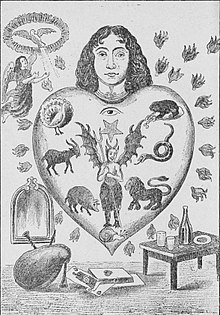
An emblematic image depicting the human being heart bailiwick to the 7 deadly sins, each represented by an creature (clockwise: toad = avarice; ophidian = green-eyed; lion = wrath; snail = sloth; pig = gluttony; caprine animal = lust; peacock = pride).
Origin of the currently recognized seven deadly sins
The modern concept of the 7 deadly sins is linked to the works of the fourth-century monk Evagrius Ponticus, who listed eight evil thoughts in Greek as follows:[viii] [9]
- Γαστριμαργία ( gastrimargia ) gluttony
- Πορνεία ( porneia ) prostitution, fornication
- Φιλαργυρία ( philargyria ) forehandedness (greed)
- Λύπη ( lypē ) sadness, rendered in the Philokalia as envy, sadness at another's good fortune
- Ὀργή ( orgē ) wrath
- Ἀκηδία ( akēdia ) acedia, rendered in the Philokalia as dejection
- Κενοδοξία ( kenodoxia ) boasting
- Ὑπερηφανία ( hyperēphania ) pride, sometimes rendered as cocky-overestimation, arrogance, or grandiosity [10]
They were translated into the Latin of Western Christianity in many writings of John Cassian,[11] [12] thus becoming part of the Western tradition's spiritual pietas or Catholic devotions equally follows:[xiii]
- Gula (gluttony)
- Luxuria/Fornicatio (lust, fornication)
- Avaritia (avarice/greed)
- Tristitia (sorrow/despair/despondency)
- Ira (wrath)
- Acedia (sloth)
- Vanagloria (vainglory)
- Superbia (pride, hubris)
These "evil thoughts" can be categorized into three types:[thirteen]
- lustful appetite (gluttony, fornication, and avarice)
- irascibility (wrath)
- mind abuse (vainglory, sorrow, pride, and discouragement)
In AD 590, Pope Gregory I revised the listing to form a more than common list.[14] Gregory combined tristitia with acedia and vanagloria with superbia , calculation green-eyed, which is invidia in Latin.[15] [16] Gregory'due south list became the standard list of sins. Thomas Aquinas uses and defends Gregory'south list in his Summa Theologica, although he calls them the "capital sins" because they are the head and course of all the others.[17] Christian denominations, such as the Anglican Communion,[18] Lutheran Church building,[19] and Methodist Church building,[20] [21] still retain this list, and mod evangelists such equally Baton Graham have explicated the seven deadly sins.[22]
Historical and modern definitions, views, and associations
Most of the seven mortiferous sins are defined by Dante Alighieri (c. 1264–1321) every bit perverse or corrupt versions of love; lust, gluttony, and greed are all excessive or matted love of good things; and wrath, envy, and pride are perverted love directed toward others' harm. The sole exception is sloth, which is a deficiency of beloved.[23] In the seven deadly sins are seven means of eternal expiry.[5] The deadly sins are more often than not associated with pride which is thought to be the male parent of all sins in lodge to help the others—which appears from lust to green-eyed.
Animalism

Animalism or lechery (Latin: luxuria (carnal)) is intense longing. It is ordinarily thought of as intense or unbridled sexual desire,[24] which may lead to fornication (including adultery), rape, bestiality, and other sinful and sexual acts; often, however, it could likewise mean other forms of unbridled desire, such as for money, or ability. Henry Edward Manning explains that the impurity of lust transforms one into "a slave of the devil".[5]
Dante divers lust as the matted dearest for individuals.[25] It is by and large thought to be the to the lowest degree serious uppercase sin,[23] [26] as it is an abuse of a faculty that humans share with animals and sins of the flesh are less grievous than spiritual sins.[27] In Dante's Purgatorio, the penitent walks within flames to purge himself of lustful thoughts and feelings. Unforgiven souls guilty of lust are also eternally diddled about in restless hurricane-like winds symbolic of their own lack of self-control of their lustful passions in earthly life and every bit shown in Dante's Inferno.[28]
Gluttony

Gluttony (Latin: gula) is the overindulgence and overconsumption of anything to the point of waste. The word derives from the Latin gluttire , meaning to gulp downwardly or eat.[ citation needed ] One reason for its condemnation is that avid the prosperous may leave the needy hungry.[29]
Medieval church building leaders such as Thomas Aquinas took a more expansive view of gluttony,[29] arguing that it could also include an obsessive anticipation of meals and over-indulgence in delicacies and plush foods.[thirty] Aquinas as well listed five forms of gluttony:
- Laute – eating too expensively
- Studiose – eating too daintily
- Nimis – eating too much
- Praepropere – eating as well soon
- Ardenter – eating too eagerly
Ardenter is often considered the most serious of these, since it is a passion for a mere earthly pleasure, which can make the committer eat impulsively or even reduce the goals of life to mere eating and drinking; for example, Esau sold his birthright for a mess of pottage with a "profane person ... who, for a morsel of meat sold his birthright" and later stated that "he institute no identify for repentance, though he sought information technology carefully, with tears".[Gen 25:30]
Greed

Greed (Latin: avaritia), as well known as avarice, cupidity, or covetousness, is a sin of want like animalism and gluttony. Nevertheless, greed (as seen by the Church building) is practical to an artificial, rapacious want besides equally the pursuit of cloth possessions. Thomas Aquinas wrote: "Greed is a sin against God, just as all mortal sins, in as much as man condemns things eternal for the sake of temporal things." In Dante's Purgatory, the penitents are jump and laid face down on the basis for having concentrated excessively on earthly thoughts. Hoarding of materials or objects, theft, and robbery, especially past ways of violence, trickery, or manipulation of authority, are all actions that may be inspired by greed. Such misdeeds can include simony, where ane attempts to purchase or sell sacraments, including Holy Orders and, therefore, positions of authority in the Church bureaucracy.[ citation needed ]
In the words of Henry Edward, forehandedness "plunges a homo deep into the mire of this globe, so that he makes it to be his god".[5]
As defined outside Christian writings, greed is an inordinate want to larn or possess more than than one needs, specially with respect to fabric wealth.[31] Similar pride, it can lead to evil.[2]
Sloth
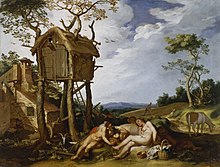
Sloth (Latin: tristitia or acedia ("without care")) refers to a peculiar jumble of notions, dating from antiquity and including mental, spiritual, pathological, and physical states.[32] It may be defined as absence of involvement or habitual disinclination to exertion.[33]
In his Summa Theologica, Saint Thomas Aquinas defined sloth as "sorrow nigh spiritual good".[ii]
The scope of sloth is wide.[32] Spiritually, acedia first referred to an affliction attending religious persons, peculiarly monks, wherein they became indifferent to their duties and obligations to God. Mentally, acedia has a number of distinctive components; the most of import of these is affectlessness, a lack of whatsoever feeling about self or other, a mind-land that gives rise to boredom, rancor, apathy, and a passive inert or sluggish mentation. Physically, acedia is fundamentally associated with a abeyance of motion and an indifference to work; it finds expression in laziness, idleness, and indolence.[32]
Sloth includes ceasing to utilise the seven gifts of grace given by the Holy Spirit (Wisdom, Understanding, Counsel, Noesis, Piety, Fortitude, and Fearfulness of the Lord); such disregard may atomic number 82 to the slowing of spiritual progress towards eternal life, the neglect of manifold duties of clemency towards the neighbor, and animosity towards those who dearest God.[5]
Sloth has also been defined equally a failure to exercise things that ane should do. By this definition, evil exists when "good" people fail to human action.
Edmund Burke (1729–1797) wrote in Present Discontents (II. 78): "No man, who is not inflamed past vain-celebrity into enthusiasm, can flatter himself that his single, unsupported, desultory, unsystematic endeavours are of power to defeat the subtle designs and united Cabals of ambitious citizens. When bad men combine, the good must associate; else they will fall, one past one, an unpitied sacrifice in a contemptible struggle."
Different the other 7 deadly sins, which are sins of committing immorality, sloth is a sin of omitting responsibilities. It may ascend from any of the other capital vices; for example, a son may omit his duty to his father through anger. The state and habit of sloth is a mortal sin, while the habit of the soul tending towards the terminal mortal state of sloth is not mortal in and of itself except under certain circumstances.[5]
Emotionally, and cognitively, the evil of acedia finds expression in a lack of any feeling for the world, for the people in it, or for the cocky. Acedia takes form as an alienation of the sentient cocky commencement from the earth and so from itself. The well-nigh profound versions of this status are institute in a withdrawal from all forms of participation in or treat others or oneself, but a lesser yet more noisome element was as well noted by theologians. Gregory the Great asserted that, "from tristitia, in that location arise malice, rancour, cowardice, [and] despair". Chaucer also dealt with this aspect of acedia, counting the characteristics of the sin to include despair, somnolence, idleness, tardiness, negligence, indolence, and wrawnesse, the last variously translated as "anger" or better as "peevishness". For Chaucer, human being's sin consists of languishing and belongings back, refusing to undertake works of goodness considering, he/she tells him/herself, the circumstances surrounding the establishment of good are likewise grievous and too difficult to suffer. Acedia in Chaucer'due south view is thus the enemy of every source and motive for work.[34]
Sloth subverts the livelihood of the body, taking no care for its twenty-four hours-to-day provisions, and slows down the mind, halting its attention to matters of great importance. Sloth hinders the man in his righteous undertakings and thus becomes a terrible source of man'due south undoing.[34]
In his Purgatorio, Dante portrayed the penance for acedia every bit running continuously at superlative speed. He describes acedia equally the "failure to love God with all i'south eye, all i'due south mind and all ane's soul". To him, it was the "eye sin", the only one characterised by an absence or insufficiency of love.[ citation needed ]
Wrath
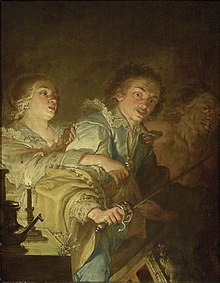
Wrath ( ira ) tin be divers as uncontrolled feelings of acrimony, rage, and even hatred. Wrath often reveals itself in the wish to seek vengeance.[35] In its purest form, wrath presents with injury, violence, and detest that may provoke feuds that can go on for centuries. Wrath may persist long after the person who did some other grievous incorrect dies. Feelings of wrath can manifest in different ways, including impatience, hateful misanthropy, revenge, and cocky-destructive behavior, such equally drug abuse, or Suicide.[ original research? ]
Co-ordinate to the Catechism of the Cosmic Church, the neutral act of acrimony becomes the sin of wrath when information technology is directed against an innocent person, when it is disproportionately strong or long-lasting, or when it desires excessive punishment. "If anger reaches the indicate of a deliberate desire to kill or seriously wound a neighbor, it is gravely against charity; it is a mortal sin." (CCC 2302) Hatred is the sin of desiring that someone else may suffer misfortune or evil and is a mortal sin when ane desires grave impairment (CCC 2302–03).
People feel aroused when they sense that they or someone they care about has been offended, when they are certain near the nature and cause of the angering event, when they are certain someone else is responsible, and when they feel that they can still influence the situation or cope with it.[36]
In her introduction to Purgatory, Dorothy L. Sayers describes wrath as "honey of justice perverted to revenge and spite".[35] In accordance with Henry Edward, angry people are "slaves to themselves".[v]
Green-eyed

Envy ( invidia ) is characterized by an insatiable want like greed and lust. It tin can be described as a distressing or resentful covetousness towards the traits or possessions of someone else. Information technology arises from vainglory[37] and severs a man from his neighbor.[v]
Malicious envy is similar to jealousy in that they both feel discontent towards someone'south traits, status, abilities, or rewards. A difference is that the envious also desire the entity and covet information technology. Envy tin can exist straight related to the Ten Commandments, specifically, "Neither shall you lot covet ... anything that belongs to your neighbour"—a statement that may too exist related to greed. Dante defined envy every bit "a desire to deprive other men of theirs". In Dante's Purgatory, the penalization for the envious is to take their eyes sewn close with wire because they gained sinful pleasure from seeing others brought low. According to St. Thomas Aquinas, the struggle angry past envy has three stages: during the get-go stage, the envious person attempts to lower another's reputation; in the eye stage, the envious person receives either "joy at another's misfortune" (if he succeeds in defaming the other person) or "grief at another's prosperity" (if he fails); and the third phase is hatred because "sorrow causes hatred".[38]
Envy is said to be the motivation backside Cain murdering his brother Abel, as Cain envied Abel because God favored Abel'southward sacrifice over Cain's.
Bertrand Russell said that envy was one of the nigh potent causes of unhappiness,[39] [ folio needed ] bringing sorrow to committers of green-eyed, while giving them the urge to inflict pain upon others.
According to the most widely accustomed views, just pride weighs downwardly the soul more than green-eyed amongst the capital sins. Like pride, envy has been associated straight with the devil, for Wisdom 2:24 states: "the envy of the devil brought death to the world".[37]
Pride
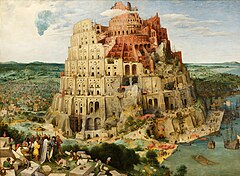
Pride ( superbia ) is considered the original and most serious of the vii deadly sins on almost every listing. It is the most angelical or demonic out of them.[40] It is also idea to exist the source of the other upper-case letter sins, known every bit hubris (from Aboriginal Greek ὕβρις) or futility. Information technology is identified as dangerously corrupt selfishness, the putting of one's own desires, urges, wants, and whims earlier the welfare of other people.
In even more destructive cases, it is irrationally assertive that one is essentially and necessarily improve, superior, or more important than others, failing to acknowledge the accomplishments of others and excessive admiration of the personal image or cocky (especially forgetting 1's own lack of divinity and refusing to acknowledge one's own limits, faults, or wrongs as a human being).
What the weak caput with strongest bias rules, Is pride, the never-failing vice of fools.
Pride has been labeled the father of all sins and has been deemed the devil's most prominent trait. C.S. Lewis writes in Mere Christianity that pride is the "anti-God" state, the position in which the ego and the self are directly opposed to God: "Unchastity, anger, greed, drunkenness and all that, are mere fleabites in comparing: it was through Pride that the devil became the devil: Pride leads to every other vice: information technology is the complete anti-God country of heed."[41] Pride is understood to sever the spirit from God, every bit well as His life-and-grace-giving Presence.[5]
One can be prideful for unlike reasons. Author Ichabod Spencer states that "spiritual pride is the worst kind of pride, if not worst snare of the devil. The middle is particularly deceitful on this one thing."[42] Jonathan Edwards said: "remember that pride is the worst viper that is in the eye, the greatest disturber of the soul's peace and sweet communion with Christ; it was the offset sin that ever was and lies lowest in the foundation of Satan's whole edifice and is the well-nigh difficultly rooted out and is the most subconscious, hole-and-corner and deceitful of all lusts and oft creeps in, insensibly, into the midst of religion and sometimes under the disguise of humility."[43]
In Aboriginal Athens, hubris was considered ane of the greatest crimes and was used to refer to insolent contempt that tin can crusade one to use violence to shame the victim. This sense of hubris could too narrate rape.[44] Aristotle defined hubris as shaming the victim merely for the committer'due south ain gratification instead of anything that happened to the committer or might happen to the committer.[45] [46] [47] The give-and-take's connotation changed somewhat over fourth dimension, with some boosted emphasis towards a gross overestimation of 1's abilities.
The term has been used to analyze and make sense of the deportment of contemporary heads of authorities by Ian Kershaw (1998), Peter Beinart (2010) and in a much more physiological manner by David Owen (2012). In this context, the term has been used to describe how certain leaders seem to become irrationally self-confident in their own abilities, when put to positions of immense ability and increasingly reluctant to mind to the advice of others and progressively more impulsive in their actions.[48] Dante'south definition of pride was "beloved of self perverted to hatred and contempt for i's neighbour". Pride is generally associated with an absence of humility.[49] [50]
Co-ordinate to the Sirach's writer's wording, the heart of a proud man is "like a partridge in its cage acting as a decoy; similar a spy he watches for your weaknesses. He changes good things into evil, he lays his traps. Just every bit a spark sets dress-down on fire, the wicked human being prepares his snares in society to draw claret. Beware of the wicked human being for he is planning evil. He might dishonor you lot forever." In another affiliate, he says that "the acquisitive man is not content with what he has, wicked injustice shrivels the middle."
Benjamin Franklin said "In reality in that location is, mayhap no one of our natural passions so hard to subdue as pride. Disguise information technology, struggle with it, stifle information technology, mortify it as much as one pleases, it is nonetheless live and will every now then peep out and bear witness itself; y'all will see it, perhaps, often in this history. For fifty-fifty if I could excogitate that I had completely overcome information technology, I should probably exist proud of my humility."[51] Joseph Addison states that "In that location is no passion that steals into the heart more than imperceptibly and covers itself under more disguises than pride."[52]
The maxim "pride goeth [goes] before destruction, a haughty spirit earlier a fall" (also wrote as "pride goeth before the fall"; from the biblical Volume of Proverbs, sixteen:18) is thought to sum upwardly the modern use of pride. Pride is also referred to as "pride that blinds," as it often causes a committer of pride to deed in foolish ways that belie common sense.[48] In other words, the modern definition may exist thought of as "that pride that goes just earlier the fall." In his 2-volume biography of Adolf Hitler, historian Ian Kershaw uses both "hubris" and "nemesis" equally titles. The first book Hubris [53] describes Hitler's early life and rise to political power. The second book Nemesis [54] gives details of Hitler's role in the Second Globe War and concludes with his autumn and suicide in 1945.
Much of the tenth and part of 11th chapter of the Book of Sirach discusses and advises about pride, hubris, and who is rationally worthy of laurels. It goes:
Exercise not store up resentment against your neighbor, no affair what his offence; do nada in a fit of anger. Pride is odious to both God and man; injustice is abhorrent to both of them.... Practise not reprehend anyone unless you have been beginning fully informed, consider the example outset and thereafter make your reproach. Practise not reply before y'all accept listened; exercise not meddle in the disputes of sinners. My child, do not undertake besides many activities. If you keep calculation to them, you will not be without reproach; if you run later them, you will not succeed nor will you always be complimentary, although you try to escape.
—Sirach, x:6–31 and eleven:one–x
In Jacob Bidermann's medieval phenomenon play Cenodoxus, pride is the deadliest of the seven deadly sins and leads directly to the damnation of the titulary famed Parisian medico. In Dante's Divine Comedy, the penitents are burdened with stone slabs on their necks to keep their heads bowed.
Historical sins
Acedia
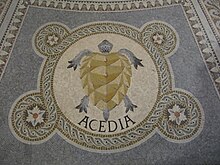
Acedia (Latin, acedia "without care"[32]) (from Greek ἀκηδία) is the neglect to have care of something that one should do. It is translated to apathetic listlessness; depression without joy. It is related to melancholy; acedia describes the behaviour and melancholy suggests the emotion producing information technology. In early on Christian thought, the lack of joy was regarded every bit a willful refusal to savour the goodness of God. Past contrast, apathy was considered a refusal to aid others in time of need.
Acēdia is negative form of the Greek term κηδεία ( Kēdeia ), which has a more restricted usage. 'Kēdeia' refers specifically to spousal love and respect for the dead.[55] The positive term 'kēdeia' thus indicates beloved for ane'south family, even through death. It also indicates beloved for those outside ane's firsthand family, specifically forming a new family with one'southward "dear". Seen in this way, acēdia indicates a rejection of familial love. Nonetheless, the pregnant of acēdia is far more wide, signifying indifference to everything one experiences.
Pope Gregory combined this with tristitia into sloth for his list. When Thomas Aquinas described acedia in his interpretation of the list, he described it as an "uneasiness of the mind", being a progenitor for lesser sins such as restlessness and instability. Dante refined this definition further, describing acedia as the "failure to honey God with all one's heart, all one's mind and all i'southward soul". To him, it was the "middle sin", the but ane characterised by an absenteeism or insufficiency of love. Some scholars[ who? ] have said that the ultimate form of acedia was despair which leads to suicide.
Acedia is currently defined in the Catechism of the Catholic Church as spiritual sloth, believing spiritual tasks to be too hard. In the fourth century, Christian monks believed that acedia was primarily caused by a state of affective that caused spiritual detachment instead of laziness.[56]

Detail of Pride from The 7 Deadly Sins and the Iv Terminal Things by Hieronymus Bosch, c. 1500
Vainglory
Vainglory (Latin, vanagloria ) is unjustified boasting. Pope Gregory viewed it every bit a course of pride, so he folded vainglory into pride for his listing of sins.[fifteen] According to Aquinas, information technology is the progenitor of envy.[37]
The Latin term gloria roughly means boasting, although its English cognate glory has come to have an exclusively positive pregnant. Historically, the term vain roughly meant futile (a significant retained in the mod expression "in vain"), but had come to take the potent egotistic undertones by the fourteenth century which it nevertheless retains today.[57] As a effect of these semantic changes, vainglory has become a rarely used word in itself and is now ordinarily interpreted every bit referring to vanity (in its modern egotistic sense).[ citation needed ]
Christian seven virtues
With Christianity, celebrated Christian denominations, such as the Cosmic Church and Protestant churches,[58] including the Lutheran Church building,[59] recognize seven virtues, which correspond inversely to each of the seven deadly sins.
| Vice | Latin | Italian | Virtue | Latin | Italian |
|---|---|---|---|---|---|
| Lust | Luxuria | Lussuria | Chastity | Castitas | Castità |
| Gluttony | Gula | Gola | Temperance | Moderatio | Temperanza |
| Greed | Avaritia | Avarizia | Charity (or, sometimes, Generosity) | Caritas ( Liberalitas ) | Generosità |
| Sloth | Acedia | Accidia | Diligence | Industria | Diligenza |
| Wrath | Ira | Ira | Patience | Patientia | Pazienza |
| Envy | Invidia | Invidia | Gratitude (or Kindness) | Gratia ( Humanitas ) | Gratitudine |
| Pride | Superbia | Superbia | Humility | Humilitas | Umiltà |
Confession patterns
Confession is the act of admitting the commission of a deadly sin to a priest who, in turn, will forgive the person in the proper name (in the person) of Christ, give a penance to make up for the sin's offence (partially), and advise the person on what he or she should do later on.[ tone ]
According to a 2009 study by the Jesuit scholar Fr. Roberto Busa, the almost common deadly sin confessed by men is lust and the most mutual deadly sin confessed by women is pride.[sixty] Information technology was unclear whether these differences were due to the actual number of transgressions committed by each sex or whether differing views on what "counts" or should be confessed caused the observed design.[61]
In art
Dante'southward Purgatorio
The 2nd book of Dante's ballsy poem The Divine One-act is structured effectually the 7 deadly sins. The most serious sins are found at the lowest level and are the irrational sins linked to the intelligent aspect, such as pride and green-eyed. Abusing ane's passions with wrath or a lack of passion as with sloth also weighs down the soul only non as much as the abuse of 1'south rational faculty. Abusing one's desires to have one's physical wants met via greed, gluttony, or lust abuses a faculty that humans share with animals. This is notwithstanding an abuse that weighs down the soul, but it does not weigh it down like other abuses. Thus, the top levels of the Mountain of Purgatory accept the top listed sins, while the lowest levels have the more serious sins of wrath, envy and pride.[62]
- luxuria / Lust[63] [64] [65]
- gula / Gluttony
- avaritia / Greed
- acedia / Sloth
- ira / Wrath
- invidia / Envy
- superbia / Pride
Geoffrey Chaucer's "The Parson'south Tale"
The concluding tale of Chaucer's Canterbury Tales "The Parson'southward Tale" is non a tale but a sermon that the parson gives against the seven deadly sins. This sermon brings together many common ideas and images about the seven deadly sins. The tale and Dante's work both show how the seven deadly sins were used for confessional purposes or every bit a way to identify, apologize of, and detect forgiveness for 1'south sins.[66] [67]
Pieter Bruegel the Elder'due south Prints of the Seven Deadly Sins
The Dutch artist Pieter Bruegel the Elder created a serial of prints showing each of the seven deadly sins. Each print features a central, labeled paradigm that represents the sin. Effectually the figure are images that show the distortions, degenerations, and destructions acquired by the sin.[68] Many of these images come from contemporary Dutch aphorisms.[69]
Edmund Spenser'south The Faerie Queene
Spenser'due south The Faerie Queene was meant to educate young people to encompass virtue and avoid vice, yet it includes a colourful depiction of the House of Pride. Lucifera, the lady of the house, is accompanied by advisers who stand for the other seven deadly sins.[ citation needed ]
William Langland's Piers Plowman
The seven sins are personified and they give a confession to the personification of Repentance in William Langland's Piers Plowman. Only pride is represented past a woman, while the others all represented by male characters.
The Vii Deadly Sins
Kurt Weill and Bertolt Brecht's The Vii Deadly Sins satirized capitalism and its painful abuses as its central character, the victim of a split personality, travels to 7 different cities in search of coin for her family unit. In each city, she encounters one of the vii deadly sins, but those sins ironically reverse one's expectations. When the character goes to Los Angeles, for instance, she is outraged by injustice, simply is told that wrath confronting capitalism is a sin that she must avoid.[ citation needed ]
Paul Cadmus' The 7 Deadly Sins
Between 1945 and 1949, the American painter Paul Cadmus created a series of bright, powerful, and gruesome paintings of each of the seven mortiferous sins.[70]
Revalorization
Ferdinand Mount maintains that liquid currentness, especially through tabloids, has surprisingly given valor to vices, causing gild to backslide into that of archaic pagans: "covetousness has been rebranded as retail therapy, sloth is reanimation, lust is exploring your sexuality, acrimony is opening upward your feelings, vanity is looking practiced because you're worth information technology and gluttony is the faith of foodies".[71]
Come across likewise
- Arishadvargas in Hinduism
- Blasphemy against the Holy Ghost
- Cardinal virtues
- Christian ethics
- Enneagram of Personality
- Eternal sin
- Five poisons in Buddhism
- 5 Thieves in Sikhism
- Chivalry Virtues
- Nafs and Tazkiah in Islam
- The Fable of The Bees: or, Private Vices, Public Benefits
- Seven Social Sins
- Sufism in Islam
- The Seven Sins of Memory
- The 7 Mortiferous Sins of Mod Times
- Theological virtues
- 3 Poisons in Buddhism
- Tree of virtues
References
- ^ a b Tucker, Shawn (2015). The Virtues and Vices in the Arts: A Sourcebook. Cascade. ISBN978-1625647184.
- ^ a b c d Aquinas, Thomas (20 Baronial 2013). Summa Theologica (All Consummate & Unabridged 3 Parts + Supplement & Appendix + interactive links and annotations). e-artnow. ISBN9788074842924.
- ^ Evagrius (2006). Evagrius of Pontus: The Greek Austere Corpus translated by Robert E. Sinkewicz. Oxford and New York: Oxford Academy Press. ISBN0199297088.
- ^ Cassian, John (2000). The Institutes. Newman Press of the Paulist Press. ISBN0809105225.
- ^ a b c d due east f grand h i Manning, Henry Edward. Sin and Its consequences.
- ^ Gaume, Jean (1883). The Canon of Perseverance; Or, An Historical, Dogmatical, Moral, Liturgical, Apologetical, Philosophical and Social Exposition of Religion. M.H. Gill & Son. p. 871.
Q. What are the upper-case letter sins? A. The capital sins are mortal sins of their own nature and the sources of many other sins. They are seven in number: pride, covetousness, lust, gluttony, envy, anger and sloth. ... Q. What other sins ought we to fear most? A. The other sins that nosotros ought to fear about are sins against the Holy Ghost and sins that weep to Heaven for vengeance.
- ^ Tilby, Angela (23 April 2013). The Vii Mortiferous Sins: Their origin in the spiritual teaching of Evagrius the Hermit. SPCK. ISBN9780281062997.
- ^ Evagrio Pontico, Gli Otto Spiriti Malvagi, trans., Felice Comello, Pratiche Editrice, Parma, 1990, p.11-12.
- ^ Evagrius of Pontus: The Greek Ascetic Corpus. Oxford: Oxford University Press. 22 June 2006. ISBN9780199297085.
- ^ In the translation of the Philokalia by Palmer, Ware and Sherrard.
- ^ "NPNF-211. Sulpitius Severus, Vincent of Lerins, John Cassian - Christian Classics Ethereal Library". www.ccel.org.
- ^ Cassian, St John (3 January 2000). The Institutes (Kickoff ed.). New York: Newman Press of the Paulist Press. ISBN9780809105229.
- ^ a b Refoule, F. (1967) "Evagrius Ponticus," In New Catholic Encyclopaedia, Vol. 5, pp. 644f, Staff of Catholic University of America, Eds., New York: McGraw-Hill.
- ^ "For pride is the root of all evil, of which it is said, equally Scripture bears witness; Pride is the beginning of all sin. [Ecclus. x, 1] Only seven principal vices, as its first progeny, leap doubtless from this poisonous root, namely, vain glory, envy, anger, melancholy, avarice, gluttony, lust." Gregory the Dandy, Moralia in Iob, book XXXI
- ^ a b DelCogliano, Marker (18 November 2014). Gregory the Great: Moral Reflections on the Book of Job, Volume 1. Cistercian Publications. ISBN9780879071493.
- ^ Tucker, Shawn R. (24 Feb 2015). The Virtues and Vices in the Arts: A Sourcebook. Cascade Books, an Imprint of Wipf and Stock Publishers.
- ^ "SUMMA THEOLOGICA: The cause of sin, in respect of one sin existence the cause of another Prima Secundae Partis, Q. 84; I-II,84,three)". world wide web.newadvent.org . Retrieved 4 December 2015.
- ^ Armentrout, Don S. (1 January 2000). An Episcopal Dictionary of the Church: A User-Friendly Reference for Episcopalians. Church Publishing, Inc. p. 479. ISBN9780898697018.
- ^ Lessing, Reed (25 August 2002). "Mighty Menacin' Midianites". The Lutheran Hr. Retrieved 26 March 2017.
- ^ Speidel, Imperial. "What Would a United Methodist Jesus Do?". UCM. Retrieved 26 March 2017.
Thirdly, the United Methodist Jesus reminds us to confess our sins. How long has it been since you lot have heard reference to the vii deadly sins: pride, gluttony, sloth, animalism, greed, envy and anger?
- ^ "Life Of A Disciple In The World 7- Seven Deadly Sins: Lust". United Methodist YouthWorker Motion. Retrieved 26 March 2017.
- ^ The American Lutheran, Volumes 39-40. American Lutheran Publicity Bureau. 1956. p. 332.
The world-renowned Evangelist, Baton Graham, presents in this volume an excellent analysis of the seven deadly sins which he enumerates every bit pride, anger, envy, impurity, gluttony, forehandedness and slothfulness.
- ^ a b Dorothy L. Sayers, Purgatory, Introduction, pp. 65–67 (Penguin, 1955).
- ^ "Definition of Lust". www.merriam-webster.com . Retrieved 4 May 2016.
- ^ Dante, Hell (1975) p. 101; Dante, Purgatory (1971) p. 67 and p. 202
- ^ Pyle, Eric (31 December 2014). William Blake's Illustrations for Dante's Divine Comedy: A Study of the Engravings, Pencil Sketches and Watercolors. McFarland. ISBN9781476617022.
- ^ Aquinas, St Thomas (1 January 2013). Summa Theologica, Volume iv (Part III, Start Section). Cosimo. ISBN9781602065604.
- ^ Dorothy Fifty. Sayers, Hell, notes on Canto Five, p. 101–102
- ^ a b Okholm, Dennis. "Rx for Gluttony". Christianity Today, Vol. 44, No. x, eleven September 2000, p.62
- ^ "Gluttony". Catholic Encyclopedia.
- ^ "greed". American Heritage Lexicon of the English Language (5th ed.). Houghton Mifflin Harcourt. 2016. Retrieved iv February 2019 – via The Free Dictionary.
- ^ a b c d Lyman, Stanford (1989). The Seven Mortiferous Sins: Society and Evil. p. 5. ISBN0-930390-81-four.
- ^ "the definition of sloth". Dictionary.com . Retrieved 3 May 2016.
- ^ a b Lyman, Stanford. The Seven Deadly Sins: Society and Evil. pp. vi–7.
- ^ a b Landau, Ronnie (xxx October 2010). The Vii deadly Sins: A companion. ISBN978-1-4457-3227-5.
- ^ International Handbook of Anger. p. 290
- ^ a b c Aquinas, St Thomas (1 Jan 2013). Summa Theologica, Volume 3 (Role II, 2nd Section). Cosimo, Inc. ISBN9781602065581.
- ^ "Summa Theologica: Treatise on The Theological Virtues (QQ[1] – 46): Question. 36 – Of Envy (four articles)". Sacred-texts.com. Retrieved 2 January 2010.
- ^ Russell, Bertrand (1930). The Conquest of Happiness . New York: H. Liverwright.
- ^ Climacus, John. The Ladder of Divine Rise, Translation by Colm Luibheid and Norman Russell. pp. 62–63.
- ^ Mere Christianity, C.S. Lewis, ISBN 978-0-06-065292-0
- ^ Lexicon of Called-for Words of Vivid Writers. 1895. p. 485.
- ^ Claghorn, George. To Deborah Hatheway, Letters and Personal Writings (Works of Jonathan Edwards Online Vol. 16).
- ^ "hubris - Definition & Examples". Britannica.com.
- ^ Aristotle. Rhetoric. p. 1378b.
- ^ Cohen, David (1995). Police, Violence and Community in Classical Athens. Cambridge University Press. p. 145. ISBN0521388376 . Retrieved six March 2016.
- ^ Ludwig, Paul W. (2002). Eros and Polis: Desire and Community in Greek Political Theory. Cambridge University Press. p. 178. ISBN1139434179 . Retrieved half-dozen March 2016.
- ^ a b Hollow, Matthew (2014). "The 1920 Farrow's Bank Failure: A Case of Managerial Hubris". Journal of Management History. Durham University. 20 (2): 164–178. doi:x.1108/JMH-eleven-2012-0071. Retrieved 1 Oct 2014.
- ^ "Humility vs Pride And Why The Deviation Should Matter To You | Jeremie Kubicek". jeremiekubicek.com . Retrieved ii March 2018.
- ^ Acquaviva, Gary J. (2000). Values, Violence and Our Time to come. Rodopi. ISBN9042005599.
- ^ Franklin, Benjamin. The Autobiography.
- ^ Dictionary of Burning Words of Brilliant Writers. 1895. p. 484.
- ^ Kershaw, Ian (1998). Hitler 1889–1936: Hubris. New York: W. W. Norton & Company. ISBN978-0-393-04671-7. OCLC 50149322.
- ^ Kershaw, Ian (2000). Hitler 1936–1945: Nemesis. New York: W. W. Norton & Company. ISBN978-0-393-04994-7. OCLC 45234118.
- ^ Henry George Liddell and Robert Scott. A Greek-English Lexicon. Revised past Sir Henry Stuart Jones and Roderick McKenzie. Oxford: Clarendon Press, 1940.
- ^ "Before Sloth Meant Laziness, It Was the Spiritual Sin of Acedia". Atlas Obscura. xiv July 2017. Retrieved 27 November 2017.
- ^ Oxford English dictionary
- ^ Immature, David (1893). The Origin and History of Methodism in Wales and the Borders. C.H. Kelly. p. 14.
For nearly a hundred years afterward the Reformation, excepting in cathedrals, churches and chapels, there were no Bibles in Wales. The first volume printed in the Welsh linguistic communication was published in 1546, by Sir John Price of The Priory, Becon and contained a translation of the Psalms, the Gospels as appointed to exist read in the churches, the Lord's Prayer, the X Commandments, a Agenda and the Seven Virtues of the Church. Sir John was a layman, a sturdy Protestant and a human being of considerable influence and ability.
- ^ Spicer, Andrew (5 December 2016). Lutheran Churches in Early Modern Europe. Taylor & Francis. p. 478. ISBN9781351921169.
The Lutheran emblem of a rose was painted in a sequence on the ceiling, while a decoratively carved pulpit included the Christo-centric symbol of a vulnerating pelican. The interior changed to a degree in the 1690s when Philip Tideman produced a series of grisaille paintings depicted the Seven Virtues (which hang from the gallery behind the pulpit), likewise as decorating the wing doors of the organ.
- ^ "Two sexes 'sin in different ways'". BBC News. eighteen February 2009. Retrieved 24 July 2010.
- ^ Morning Edition (20 Feb 2009). "Truthful Confessions: Men And Women Sin Differently". Npr.org. Retrieved 24 July 2010.
- ^ Climacus, John. The Ladder of Divine Ascent, Translation by Colm Luibheid and Norman Russell. pp. 62–63.
- ^ Godsall-Myers, Jean East. (2003). Speaking in the medieval globe. Brill. p. 27. ISBNninety-04-12955-3.
- ^ Katherine Ludwig, Jansen (2001). The making of the Magdalen: preaching and popular devotion in the later Center Ages. Princeton Academy Press. p. 168. ISBN0-691-08987-six.
- ^ Vossler, Karl; Spingarn, Joel Elias (1929). Mediæval Culture: The religious, philosophic and ethico-political background of the "Divine Comedy". University of Michigan: Constable & company. p. 246.
- ^ "The Canterbury Tales". CliffsNotes . Retrieved thirty June 2017.
- ^ "Dante'due south Inferno and Saint Augustine's Confessions". h2g2 . Retrieved 30 June 2017.
- ^ Orenstein, Nadine G., ed. (1 September 2001). Pieter Bruegel the Elder: Prints and Drawings. New York: Metropolitan Museum of Art. ISBN9780300090147.
- ^ Klein, H. Arthur (i January 1963). Graphic Work of Peter Bruegel, the Elder: Reproducing 64 Engravings and a Woodcut After Designs Past Peter Bruegel the Elderberry (1st Edition / 1st Printing ed.). Dover Publications.
- ^ "Paul Cadmus | The Vii Mortiferous Sins: Pride". www.metmuseum.org . Retrieved four December 2015.
- ^ F. Mount, Full Circumvolve (2010) p. 302
Further reading
- Tucker, Shawn. The Virtues and Vices in the Arts: A Sourcebook, (Eugene, OR: Pour Press, 2015)
- Schumacher, Meinolf (2005): "Catalogues of Demons as Catalogues of Vices in Medieval German Literature: 'Des Teufels Netz' and the Alexander Romance by Ulrich von Etzenbach." In In the Garden of Evil: The Vices and Civilisation in the Eye Ages. Edited by Richard Newhauser, pp. 277–290. Toronto: Pontifical Constitute of Mediaeval Studies.
- The Divine Comedy ("Inferno", "Purgatorio" and "Paradiso"), by Dante Alighieri
- Summa Theologica, by Thomas Aquinas
- The Concept of Sin, past Josef Pieper
- The Traveller's Guide to Hell, past Michael Pauls & Dana Facaros
- Sacred Origins of Profound Things, by Charles Panati
- The Faerie Queene, by Edmund Spenser
- The Seven Mortiferous Sins Series, Oxford Academy Printing (7 vols.)
- Rebecca Konyndyk DeYoung, Glittering Vices: A New Await at the 7 Deadly Sins and Their Remedies, (Grand Rapids: BrazosPress, 2009)
- Solomon Schimmel, The Seven Deadly Sins: Jewish, Christian and Classical Reflections on Homo Psychology, (New York: Oxford University Press, 1997)
- "Md Faustus" by Christopher Marlowe
External links
- Cosmic Catechism on Sin
- Medieval mural depictions – in parish churches of England (online catalog, Anne Marshall, Open University)
- Stranger, An Allegorical Tale of the Seven Mortiferous Sins, ISBN 9781311073846
hollowaytanduch70.blogspot.com
Source: https://en.wikipedia.org/wiki/Seven_deadly_sins
0 Response to "Where in the Bible Can I Read About Gluttony"
Post a Comment