The real issue behind Scottish Independence
 At that place is something quite surreal about the prospect of a vote, past those who happen to reside in Scotland at the moment, on whether or non the 300-year-former Marriage of Great U.k. should keep. Despite the opinion polls, I have a sneaky feeling that it will be a adequately clear 'No' vote. Because of the emotive nationalism, my sense is that people are reluctant to tell anyone that they are planning to vote 'No', and so the pollster results are skewed towards 'Yes.'
Only whatsoever the event, there are going to be some serious recriminations near the way the whole procedure has been conducted. It is breathtaking to consider the misjudgements, incompetence and constitutional wrecking that has marked the whole process. These are the nearly obvious blunders:
- Cameron insisting that the vote was a direct 'yes' or 'no', out of hubristic conviction that Scots would not dare to vote 'yes', instead of including a tertiary option.
- Assuasive the 'better together' position to exist called 'No.' Not surprisingly, this looks rather negative, as does whatsoever campaign to maintain the condition quo. If there had been any thought at all about this, the vote would have been cast as between 'yep to independence' versus 'yes to marriage'—or, better still, 'yeah to matrimony' versus 'no to union.'
- Putting that 3rd option (the then-called 'devo max') selection on the tabular array the week before the vote, which looks to everyone like a cross between a panic measure out and a ransom.
- The sloppy definition of who can vote, so that residents in Scotland with no long-term stake can vote, whereas those who take a long Scottish heritage but happen to take moved to England or some other country cannot.
- The notion of making constitutional change on a mere 50% of those voting. Even a debating society has a 2/3 threshold for constitutional alter—and if in that location is less than 100% turnout, this change could happen with a minority of the electorate voting for it, allow alone a minority of all Scots.
- The idea that one office of the United Kingdom can vote itself independent regardless of the will of the balance of the Matrimony. Scotland comprises 8% of the UK population—and then why couldn't other areas with 8% too decide to secede? At what percent does the other half have a say?
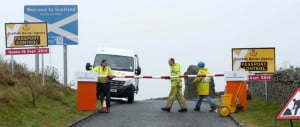
What is besides striking is the fact that some really key questions have non been answered which have a pregnant bearing on whether independence volition 'piece of work'. What currency volition Scotland apply? It is hard to seeing rUK allowing Scotland to use the pound—which and so raises the question of international credit. A newly independent Scotland won't be granted a AAA credit rating, which means that servicing its portion of the national debt volition exist more expensive. Can it bring together the Eu? This is unlikely to happen soon, but when information technology does information technology will probably exist on condition that Scotland joins the Euro, and if so it would, in many regards, have less fiscal autonomy in relation to Brussels than it now has from London. And it might well have to join the Schengen agreement on borderless motility of people—so the recent joke Scottish Border Patrol someone fix will get a reality. I wonder what economic bear on that will have on the North East? And notwithstanding they too have no say on this.
At present the divide for them is just a jagged line on a map, which they cantankerous with neat regularity virtually as if it were not there. Wellness, education, work, shopping, veterinarian intendance – these are just some of the things for which people hop over the purlieus in an area where many people regard themselves every bit "Borderers" first – English or Scots second. And with talk of border controls, new currency and tax systems, and even a different time zone should Scotland opt to become information technology solitary, it's like shooting fish in a barrel to see why a yes vote could be huge for those Borderers.
 Merely it is not really the case that answers have not been offered—the questions have been debated, and quite fully. The BBC Daily Question has explored most of the primal issues from both sides of the contend, and many are finely poised. I was surprised to learn that the average taxation paid per person in Scotland is more than or less exactly the aforementioned equally that paid in the UK as a whole. Public spending, governed in part by the Barnett Formula, is higher in Scotland than in England (though not as loftier as in Northern Ireland) but the gap is fabricated up for by oil revenues. Some other central question is whether food prices would go upward. All other things beingness equal, this is likely, since distribution costs are higher—but 'all other things' are non probable to remain equal, and changes in the taxation regime could protect lower costs. The economic arguments have put the 'No' entrada in a double bind: mention them and it looks patronising ('We are helping you out'); say nothing and y'all omit what could be a key role of your argument.
Will the NHS however office in Scotland? Considering of devolution, information technology did non follow the marketisation that Andrew Landsley imposed in England, and waiting lists have not met the targets ready. Scotland has large health challenges, constantly topping the chart for obesity and coming at the lesser of league tables for life expectancy. (A man born today in sure areas of Glasgow has a life expectancy in the 50s.) Just in Scotland the health service has not faced the same 'battle for its heart and soul' that has happened in England, and perhaps it has found a ameliorate fashion of working. Perhaps.
No, the issue is that, on many of these things, we simply don't know, and can't know, since there are so many uncertainties. The globe equally it is today feels a very uncertain place to be a small country—and notwithstanding many Scots announced to want to have the chance.
It has been quite difficult to find any theological basis on which to form a view on this. (I don't think the fact that 'Alec Salmond' is an anagram of 'Call every bit demon' really counts here…especially when I have misspelled Alex!) There is a nice piece making a plea for continued Union on Fulcrum by David Barclay. The core is his argument is that, since Christ has united people, we should run into to stay together wherever possible.
Some see difference every bit an opportunity for sectionalisation, for choice and separateness – a adventure to fragment into smaller and smaller groups to effort and maximise our happiness. But the Bible offers a different perspective. Ephesians 2:xiii-fourteen says "now in Christ Jesus yous who once were far abroad take been brought near by the blood of Christ. For he himself is our peace, who has fabricated the two groups 1 and has destroyed the barrier, the dividing wall of hostility". As those who have gone from being foreigners and strangers to being brought into the family of God, we should seek as far as is practically possible to intermission downwardly barriers and extend the boundaries of our communities.
But I am not certain the logic of this works. Surely we should seek unity with those in other countries, not seek only to eliminate country borders? This argument would, in fact, support the creation of a European super-state, and there are some expert theological arguments against that. The main objection to larger and larger unions is the loss of contact between those governing and those existence governed—often expressed every bit the 'democratic deficit.' And in fact it is this which is driving the determination for Scottish independence. Equally the Scottish Government's own White Paper has put information technology:
Devolution has shown the strengths of having different political systems in Scotland and the remainder of the United kingdom for both countries. Since 1999 many areas of Scottish life, including health, justice and education, accept to all intents and purposes been independent.
The Scottish approach to these bug – for instance, banning smoking in public places, protecting gratis education and pushing for a minimum price for booze – has challenged the rest of the UK to consider different approaches to address challenges mutual to both countries. We have also been able to consider the Westminster approach to policy problems, sometimes rejecting those that are non suitable for Scotland or that have no support hither.
With a Cabinet fatigued from the social elite, politicians being 'forced' to accept an eleven% pay ascent at the same time they reject a one% rise for NHS staff, and a general sense of the political class beingness out of touch with ordinary voters, the Scottish referendum is highlighting something felt across the state. In fact, as Johann Hari pointed out during the fence on proportional representation, our electoral system constantly fails to reflect the wishes of most people.
In Great britain today, nosotros have a centre-left majority who desire this to be a country with European-level taxes, European-standard public services and European-level equality. We accept had this for a very long time. Fifty-fifty at the tiptop of Thatcherism, 56 per cent of people voted for parties committed to higher taxes and higher spending. But the centre-left vote is separate between several parties – while the right-fly vote clusters around the Conservatives. So under FPTP they get to rule and dominate out of all proportion to their actual back up, and drag most of us in a direction we don't desire to get.
And this distance between the desire of the governed and the volition of the governing is just what Samuel warned the people of State of israel well-nigh when they wanted to change their organisation of Government and have their own king like the other nations:
This is what the male monarch who will reign over you will claim as his rights: He will have your sons and make them serve with his chariots and horses, and they will run in front of his chariots. Some he will assign to be commanders of thousands and commanders of fifties, and others to plow his basis and reap his harvest, and still others to make weapons of war and equipment for his chariots. He will take your daughters to be perfumers and cooks and bakers. He will take the all-time of your fields and vineyards and olive groves and give them to his attendants. He volition take a tenth of your grain and of your vintage and give it to his officials and attendants. Your male and female person servants and the all-time of your cattled and donkeys he will take for his ain use. He will accept a 10th of your flocks, and you yourselves will get his slaves. When that day comes, yous will cry out for relief from the king y'all have called, but the LORD volition non answer you in that day. (i Sam viii.xi–xviii)
Perhaps Thursday's vote, whatever the effect, will be a wake-up call for the whole nation to rethink what it wants from its Authorities.
If you have valued this post, would you considerdonating £i.20 a month to support my work?
If yous enjoyed this, do share it on social media (Facebook or Twitter) using the buttons on the left. Follow me on Twitter @psephizo. Like my page on Facebook.
Much of my work is washed on a freelance basis. If you accept valued this post, you can make a single or repeat donation through PayPal:
Comments policy: Proficient comments that engage with the content of the post, and share in respectful debate, can add together existent value. Seek beginning to understand, so to be understood. Make the most charitable construal of the views of others and seek to learn from their perspectives. Don't view debate as a conflict to win; address the statement rather than tackling the person.
hollowaytanduch70.blogspot.com
Source: https://www.psephizo.com/life-ministry/the-real-issue-behind-the-scottish-independence-vote/
0 Response to "The real issue behind Scottish Independence"
Post a Comment